The Habit Tracker Trap: When Tracking Becomes the Procrastination
The Habit Tracker Trap: When Tracking Becomes the Procrastination occurs when you spend more time color-coding progress than doing the work. This happens because checking a box triggers a dopamine...

ScoreRead Editorial Team
Editorial Team
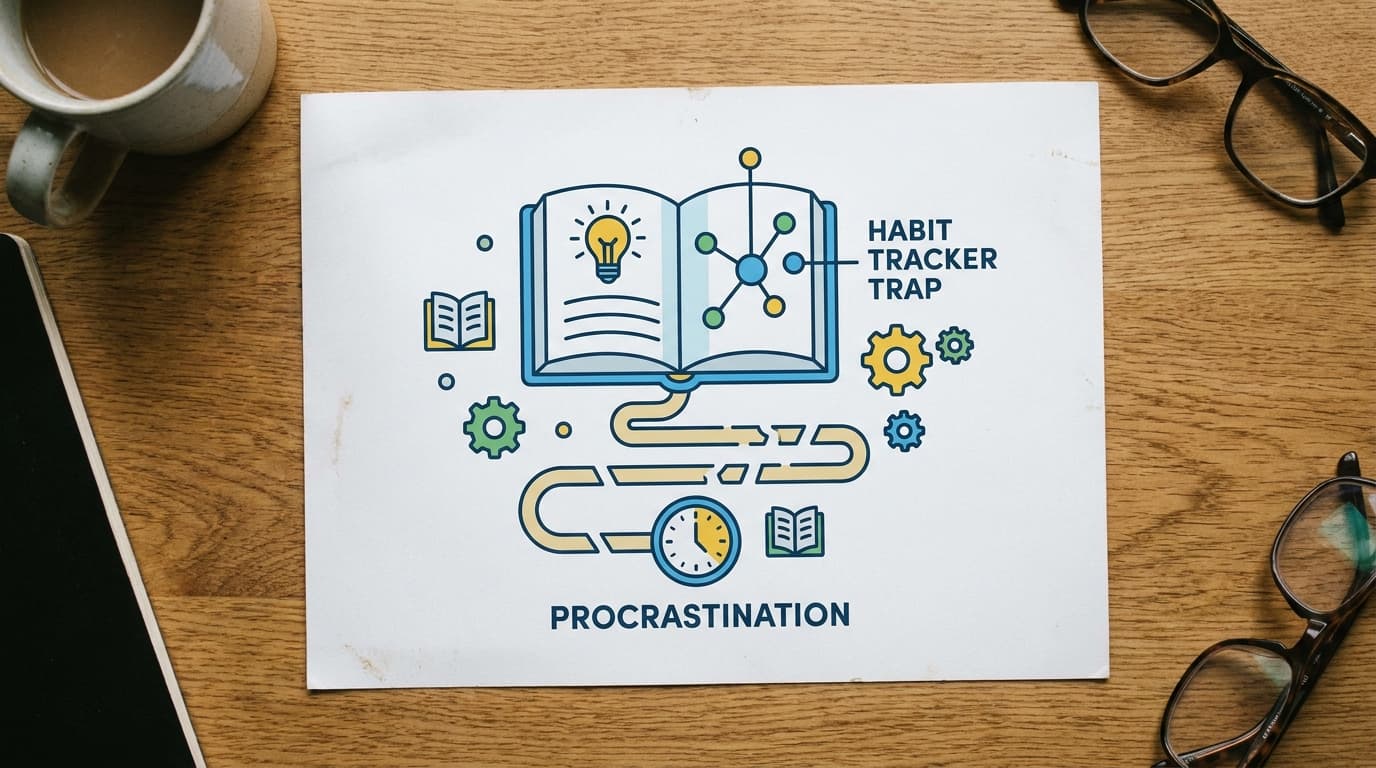
The Habit Tracker Trap: When Tracking Becomes the Procrastination
The Habit Tracker Trap: When Tracking Becomes the Procrastination occurs when you spend more time color-coding progress than doing the work. This happens because checking a box triggers a dopamine hit that tricks your brain into feeling productive while the real task stays untouched.
It's a form of self-sabotage where easy organization replaces hard action. If your streaks are high but your results are low, you're likely using your tracker to avoid discomfort.
You'll learn why your brain chooses tracking over work and how to simplify your system to get results again.
Table of Contents
- Why Your Brain Chooses Tracking Over Actual Work
- Understanding the Science of Task Avoidance
- How to Spot the Habit Tracker Failure Mode
- Using High-Stakes Accountability to Break the Cycle
- 3 Ways to Turn Your Tracker Back Into a Useful Tool
- Frequently Asked Questions
- Conclusion
Why Your Brain Chooses Tracking Over Actual Work
Your brain loves easy wins. When you face a hard task, your limbic system—the part of your brain focused on immediate feelings—craves relief from the stress. Checking a box on a habit tracker provides that relief instantly. It feels like progress, but it's actually a way to avoid the discomfort of the real work. This is why you might feel productive while your most important goals remain untouched.
Recent findings show that procrastination is primarily a mechanism for emotional regulation rather than just being lazy. fMRI scans reveal that habitual procrastinators often have weaker connections between the rational prefrontal cortex and the emotional limbic system. When the limbic system screams for comfort, the rational brain fails to override it. You choose the safe task of organizing your tracker because it feels better than the scary task of doing deep work.
Imagine an entrepreneur who needs to pitch to investors to save their business. Instead of sending the emails, they spend the entire morning refining the categories and color codes on their habit tracking app. They tell themselves they are optimizing for discipline and consistency, but they are really just hiding from potential rejection. As Alex Hormozi points out, it doesn't count as being busy if you're working on things that don't matter to avoid the things that do.
This is the core of the habit tracker failure mode. You are busy, but you aren't making progress. This type of false productivity often shows up when we tweak safe elements, like app settings or notebook layouts, to avoid high-resistance tasks. If your streaks are high but your real-world results are low, your tracker has become a shield against the effort required to grow.
Some people use extreme measures to fight this emotional resistance and force action. They might set up a system where they have to give a friend $100 if they don't finish a high-impact task by a specific deadline. This shifts the emotional math, making the discomfort of losing money greater than the discomfort of doing the work. It forces the brain to stop playing with the tracker and start moving the needle.
- Set a strict two-minute daily limit for all habit tracking activities to prevent them from becoming a task of their own.
- Only mark a habit as complete once the actual work is 100% finished.
- Audit your results monthly by checking if your habit streaks actually match your real-world progress.
- Switch to a simple binary yes/no paper grid if you find yourself over-optimizing your digital tracking app.
- Track only one keystone habit at a time to avoid the cognitive overload that leads to task avoidance.
The Dopamine Hit of False Productivity
Checking a box on your tracker releases a quick burst of dopamine, making you feel successful before you've actually achieved anything. This happens because procrastination is often an emotional regulation strategy. Your brain seeks the relief of a small win to soothe the anxiety of a difficult task, making mental clarity hard to find.
Imagine a student who spends hours organizing digital folders instead of writing an essay. This "productive" procrastination is a neurological trap where the prefrontal cortex fails to override the limbic system's desire for comfort. It feels like progress, but research shows procrastination is about emotional regulation rather than laziness.
- Log habits only after the work is 100% finished to avoid premature rewards.
- Set a two-minute daily limit for tracking to prevent it from becoming its own task.
- Audit streaks against real-world progress monthly to ensure you are actually moving forward.
Understanding the Science of Task Avoidance
Procrastination is not a sign of laziness or a lack of character. It is actually a battle between two parts of your brain that have very different goals. Your limbic system is the emotional center that wants immediate relief from stress and discomfort. Your prefrontal cortex is the rational side that handles long-term planning and goals. When a task feels scary or boring, the emotional side usually wins the fight. This is why you choose to scroll on your phone or organize your desk instead of starting a difficult project.
This struggle is often caused by what scientists call executive dysfunction. Research using fMRI scans showing that procrastinators often have weaker neurological connections between their rational and emotional centers. Because these pathways are not as strong, the rational part of the brain has a harder time overriding the urge to seek comfort. It is an emotional regulation problem rather than a lack of discipline. This is why managing your emotions and energy is more effective than just trying to manage your time.
Imagine an entrepreneur who needs to pitch to a big investor. This is a high-pressure task that triggers a lot of anxiety and self-doubt. Instead of writing the pitch, they spend three hours color-coding their habit tracker and setting up new categories for things like health and social goals. They feel productive because they are working on their business systems, but they are actually just avoiding the emotional weight of the pitch. This is the specific failure mode where maintaining the tool replaces doing the work. You can tell this is happening if your habit streaks are perfect but your real-world progress has stalled for weeks.
To get out of this loop, you have to recognize when safe tasks are replacing scary ones. You might be rewatching lectures or organizing digital folders to feel a sense of control. This is a form of false productivity that gives you a quick dopamine hit without any actual results. Reading books for consistency and growth can help you build systems that focus on action rather than just organization. Once you see the trap, you can shift your focus back to the habits that actually move the needle.
The key is to stop shaming yourself for the delay and start lowering the emotional stakes of the task. When you stop worrying about the tracker and start focusing on the work itself, the neurological friction begins to fade. Your brain needs to feel safe enough to start, so the initial goal should be as small as possible. This approach bypasses the limbic system's panic response and allows your rational mind to take the lead again.
- Use emotional labeling to name the specific discomfort you feel before starting a hard task.
- Set a strict two-minute daily limit for all habit tracking activities to keep them from becoming a distraction.
- Audit your results monthly by checking if your habit streaks match your actual real-world achievements.
- Start high-resistance tasks with a tiny version that takes only five minutes to complete.
- Consider using financial stakes, like giving a friend $100 if you fail a high-impact task, to increase the cost of avoidance.
Neurological Executive Dysfunction
Procrastination isn't a character flaw. It’s a neurological battle between two brain regions. fMRI scans show that chronic procrastinators have weaker connections between the prefrontal cortex, which handles logic, and the limbic system, which controls emotions. When a task feels scary, your emotional center takes over to find relief. Understanding these personality types and growth books helps you manage these impulses.
Imagine a freelancer who spends all morning perfecting their habit app layout instead of sending client pitches. They feel productive while 'organizing,' but they are really just hiding from the fear of rejection. This is a common trap where maintaining the tool replaces the work. You feel busy, but you aren't actually making progress.
- Label your feelings by naming the specific discomfort out loud before you start a task.
- Set a strict two-minute limit for tracking to keep it from becoming a distraction.
- Start hard tasks with a tiny, five-minute version to bypass your brain's resistance.
How to Spot the Habit Tracker Failure Mode
You can tell your habit tracker has failed when the act of checking a box feels more important than the habit itself. This happens because tracking is a low-resistance task that provides an immediate hit of dopamine. It makes you feel successful even if you haven't moved the needle on your big goals. This is the core of the habit tracker trap where you swap high-impact work for the comfort of organization.
This behavior is a way for your brain to handle stress rather than a sign of laziness. Recent findings show that procrastination is primarily a mechanism for emotional regulation rather than a lack of time management. When a task feels intimidating, your brain looks for a safe way to feel productive. Organizing your tracker is a perfect hiding spot because it looks like work while helping you avoid the discomfort of a difficult challenge.
This often shows up as false productivity in the workplace or in school. You might see a student who spends three hours color-coding their notes or rewatching lectures to avoid the actual work of writing a paper. They feel busy and productive, but they are stuck in a loop of low-effort tasks. Reading about improving focus and concentration can help you identify when you are just spinning your wheels.
Imagine an entrepreneur who needs to pitch to ten investors to save their startup. Instead of making those scary phone calls, they spend all morning refining their habit app categories and picking custom icons for their wealth goals. They end the day with a perfect streak in their app, but they haven't made a single call. They feel busy because they were active, but they have actually engaged in self-sabotage by choosing a safe task over a necessary one.
If you find yourself overthinking every detail of your system, you might be using the tool to hide from the work. It is easy to get lost in the aesthetics of a tracker instead of the results. Using books for overthinking and mental clarity can provide strategies to stop this cycle before it wastes your entire day. You need to focus on what the data tells you about your real-world progress.
To break free, you must audit your results rather than your streaks. A long string of checkmarks does not mean much if your bank account, fitness level, or project status hasn't changed. You might be winning the game of tracking while losing the game of life. Comparing your app data to your actual achievements is the only way to see if you are truly moving forward or just running in place.
- Audit your results by comparing your habit streaks to your actual real-world achievements once a week.
- Set a strict time limit for how long you spend inside your tracking app or journal each day.
- Notice when you are tinkering with the system instead of doing the high-resistance tasks it monitors.
- Look for signs of false productivity like re-organizing lists or re-reading instructions to avoid starting work.
- Use books like Atomic Habits for consistency to refocus on the small actions that lead to big results.
Using High-Stakes Accountability to Break the Cycle

Procrastination is not a time management problem or a sign of laziness. It is actually a mechanism for emotional regulation. When you face a task that feels overwhelming or boring, your brain looks for a way to avoid that immediate discomfort. Because habitual procrastinators often have weaker neurological connections between the rational prefrontal cortex and the emotional limbic system, the urge to find a distraction usually wins over the desire to be productive.
To break this internal tug-of-war, you have to make the cost of quitting higher than the cost of doing the work. This is where high-stakes accountability becomes a powerful tool. By introducing a financial penalty, you are using negative reinforcement to override your brain's desire for immediate relief. You are essentially forcing your executive function to wake up by creating a consequence that is more painful than the task itself.
Imagine an entrepreneur who has spent two weeks tweaking their website graphics to avoid the scary job of pitching to investors. They finally call a friend at 9 AM and say, I will give you $100 if I do not send you a screenshot of three sent pitch emails by 5 PM today. Suddenly, the discomfort of rejection feels much smaller than the physical pain of losing a hundred dollars. The fear of the penalty creates a new emotional pressure that cancels out the anxiety of the work.
This strategy works best for high-resistance, high-value habits in categories like career growth or health. You can also look into personality types books to understand why your specific brain type might lean toward these avoidance patterns. Only use these stakes for the big, scary tasks that actually move the needle in your life. If you try to use financial bets for every minor chore, you will quickly burn out and lose the effectiveness of the system.
- Pick a referee who is firm enough to take your money if you fail to meet the deadline.
- Set a strict, binary deadline like 5 PM sharp to prevent your brain from negotiating for more time.
- Select a penalty amount that is high enough to hurt but not so high that it causes genuine financial ruin.
- Limit these high-stakes bets to your top three most avoided high-impact tasks each month.
- Check out books for overthinking and mental clarity to help reduce the mental friction before you even need to set a bet.
3 Ways to Turn Your Tracker Back Into a Useful Tool
To turn your tracker back into a tool, you must stop treating it like a hobby. The habit tracker trap happens when the act of checking a box gives you a dopamine hit that feels like progress, even if you haven't moved the needle on your real goals. If your tracking system is more complex than the habit itself, you are likely using it as a form of false productivity to avoid the discomfort of the actual work.
Recent findings show that procrastination is primarily a mechanism for emotional regulation rather than a lack of time management. Your prefrontal cortex knows you should work, but your limbic system craves the immediate relief of a low-resistance task. Logging data in a colorful app is the perfect way to satisfy that craving without actually doing the hard thing. To fix this, you need to strip away the noise and return to a system that prioritizes action over aesthetics.
Imagine an entrepreneur who spends her most productive morning hours refining categories like health, wealth, and social goals in a high-tech app. She feels busy and organized, but she hasn't sent a single sales email. By the time she finishes her 'Mission Domination' checklist, her mental energy is gone. This is a classic failure mode where the tracker becomes the work. She would be better off with a single index card and a pen, focusing only on the one task she is most afraid to start.
If you find yourself stuck in this loop, reading books like Atomic Habits for consistency can help you understand how to build systems that actually stick. You might also benefit from books for improving focus to help you stay on task when the tracker tries to pull you away into busywork. The goal is to spend less than two minutes a day on the tracker so you can spend the rest of your time on the habit.
The most effective way to reset is to move from digital complexity to analog simplicity. A simple 31-day binary grid on paper removes the friction of notifications and app updates. It forces you to confront a simple 'yes' or 'no' regarding your progress. This shift helps manage your emotional resistance by making the tracking process so boring that it can no longer serve as a distraction from your high-impact tasks.
- Track only one 'keystone' habit at a time to avoid cognitive overload and decision fatigue.
- Switch to a simple binary paper grid where you only mark a 'Yes' or 'No' for the day.
- Set a strict two-minute daily limit for all habit tracking activities to prevent it from becoming a procrastination tool.
- Audit your results weekly by comparing your 'streaks' to your real-world progress in that area.
- Focus on managing your emotional energy rather than just your time to overcome the urge to hide in low-stakes tasks.
Frequently Asked Questions
It definitely can. When you focus on the tracker instead of the habit, you are likely experiencing a neurological disconnect. Research shows that people who struggle with procrastination often have weaker connections between the prefrontal cortex and the limbic system. This makes it harder for your rational brain to override the part of you that just wants to feel good right now.
You might notice this when you spend your morning updating your tracking app instead of starting your hardest project. It feels like work, but it is actually a way to avoid the emotional discomfort that comes with difficult tasks.
That hit comes from your brain rewarding you for completing a task, no matter how small it is. This is a form of false productivity. It is common in school where students might spend hours re-organizing their notes or re-watching old lectures to avoid the actual stress of studying new material because the organizing feels easier and yields a quick reward.
To break this cycle, some people use negative reinforcement to make the easy path more painful. For instance, some habit systems involve giving a friend $100 if you fail to meet your goal. When the cost of skipping the hard work is that high, the small dopamine hit from a simple checkmark stops being enough of a distraction.
It really comes down to how much friction you need to stay honest. Apps are convenient, but they also make it very easy to mindlessly tap a button and get a dopamine hit without doing the actual work. This is the core of the tracker trap.
If you find yourself falling into that cycle, switching to a physical 31-day grid can help. Paper forces you to physically pick up a pen, which creates a tiny moment of reflection that apps usually skip. This layout often breaks habits into categories like Health or Wealth, making your progress feel more like a project than just another notification on your phone.
If tracking isn't enough, your brain's limbic system is likely winning the battle for immediate comfort. You might need to raise the stakes by using a negative reinforcement strategy that creates immediate consequences for failure.
Instead of just hoping for the best, some people use financial penalties, like giving a friend $100 if they miss a day. It sounds extreme, but for habitual procrastinators with weaker neurological connections between their rational and emotional brain centers, a scary immediate consequence like losing money is often the only thing that outweighs the discomfort of the task itself.
Conclusion
So what does this mean for your daily routine? The Habit Tracker Trap: When Tracking Becomes the Procrastination happens because our brains are experts at finding the path of least resistance. We trade the hard work of writing, exercising, or building a business for the easy dopamine of checking a digital box. It feels like progress, but it is just a high-tech way to stay stuck.
You can spot this failure mode by looking at your actual results instead of your app. If your streaks are perfect but your life looks exactly the same as it did a month ago, the tracker has become the distraction. Real change usually happens in the messy space where there is no checkbox, only the effort itself.
Your next move is simple. Try tracking just one thing on a piece of paper or, better yet, delete the complex app that takes ten minutes to update. Focus on doing the task you have been avoiding instead of organizing it. The goal is to build a life where you do not need a tracker to prove you are making progress.

Send it to someone who should read it next.
About the author

ScoreRead Editorial Team
Editorial Team
Every article on ScoreRead is researched, written, and edited by our editorial team before publishing, so the ideas we cover stay accurate, clear, and genuinely useful.
View all articles