Environment Design Beats Willpower — Here's What That Looks Like in a Small Apartment
Willpower is a finite resource that often fails when you are stressed or tired but Environment Design Beats Willpower — Here's What That Looks Like in a Small Apartment.

ScoreRead Editorial Team
Editorial Team
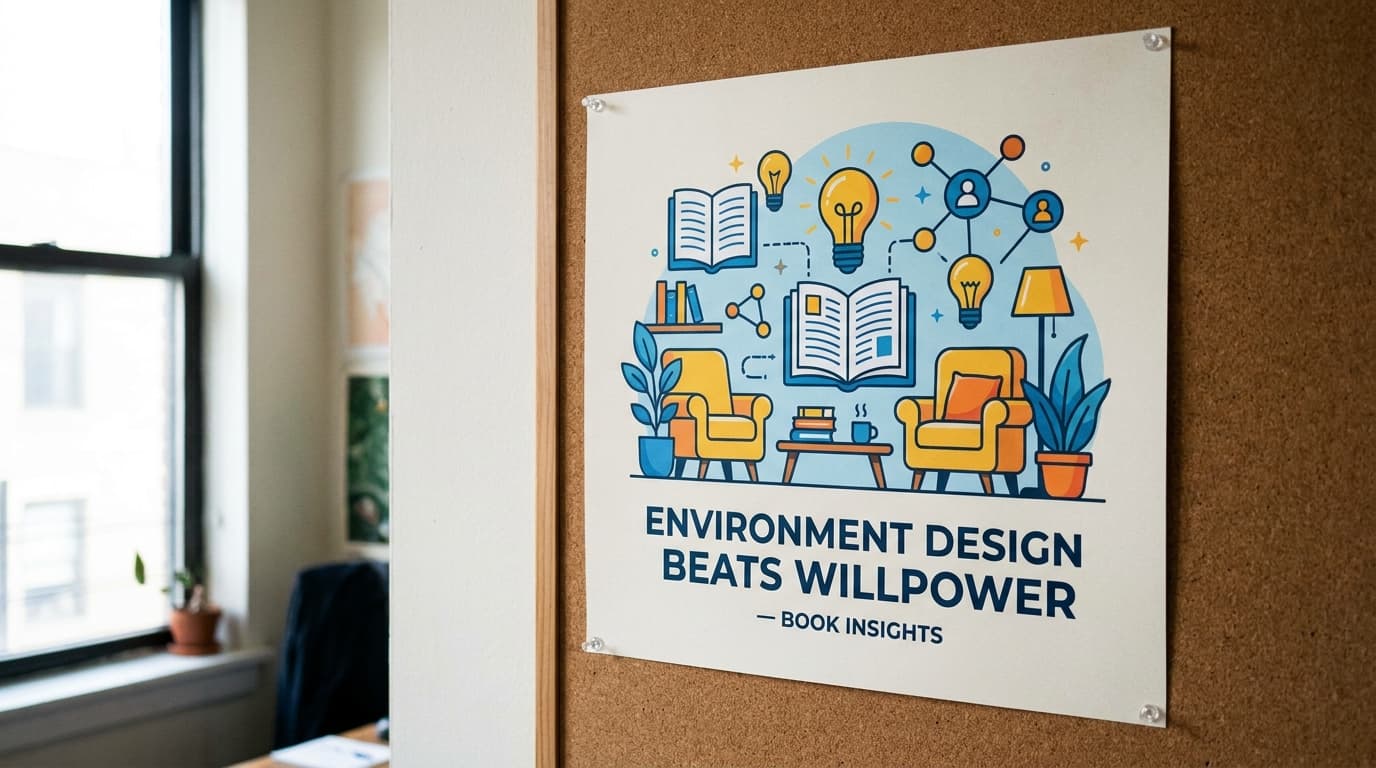
Environment Design Beats Willpower — Here's What That Looks Like in a Small Apartment
Willpower is a finite resource that often fails when you are stressed or tired but Environment Design Beats Willpower — Here's What That Looks Like in a Small Apartment.
Instead of relying on your resolve, you can change your physical surroundings to make healthy choices the path of least resistance. Since your kitchen is often your office, you can control every square inch within reach.
This guide shows you how to use choice architecture and friction reduction to turn a cramped living space into a place where good habits happen by default.
Table of Contents
- Environment Design Beats Willpower — Here's What That Looks Like in a Small Apartment
- Why Does Environment Design Beat Willpower in Tight Spaces?
- How to Create a 'Bliss Station' When You Only Have One Room
- Reducing Friction When Your Gym Is Next to Your Bed
- Managing Your Nervous System in a Cramped Environment
- Can Your Kitchen Layout Improve Your Gut Health?
- Getting Started: The 7-Day Space Sprint
- Summary: Design Your Way to Better Habits
- Frequently Asked Questions
- Conclusion
Environment Design Beats Willpower — Here's What That Looks Like in a Small Apartment
Relying on grit is a losing game because your resolve drains like a battery. In a tight space, "choice architecture" makes the right actions easier than the wrong ones. Since 90% of your serotonin is produced in the gut, your kitchen layout directly influences your mood and focus.
Imagine waking up in a studio where your yoga mat is already unrolled. You don't have to search for it because you just step onto it. This uses the B=MAP formula of Motivation, Ability, and a Prompt to turn a corner into a bliss station. It applies Atomic Habits in real life so you act without a fight.
- Stage your tools the night before to reduce the cognitive load of starting.
- Place a kettlebell by the coffee maker to trigger movement while the water boils.
- Move your phone charger to a far corner to protect your attention and sleep.
Why Does Environment Design Beat Willpower in Tight Spaces?
In a small studio, your environment is always talking to you. Most habit advice tells you to find more discipline, but BJ Fogg’s B=MAP formula proves that behavior only happens when motivation, ability, and a prompt align. When you are living in a tight space, 'ability' is the most important factor. If you have to move a chair and a stack of books just to find your workout gear, your ability to start is low. By focusing on environment design, you stop relying on the fickle strength of your resolve and start relying on the physical layout of your room.
This is where choice architecture and 'nudge theory' become your best friends, especially when your kitchen is also your home office. Nudge theory is about making the preferred action the path of least resistance. If you are working at your dining table and a bowl of fruit is at eye level, you are far more likely to grab an apple than if you have to dig through a cluttered pantry for a snack. Rearranging your most-used items to be the most visible reduces the mental energy required to make a good choice.
Imagine waking up in a cramped apartment with a goal to stretch. If your yoga mat is tucked away in the back of a dark closet, the cognitive load of clearing space and retrieving the mat often outweighs your morning motivation. Now, compare that to a scenario where the mat is already unrolled next to your bed. The prompt is immediate, and the friction is zero. You don't need willpower because the environment has already made the decision for you.
Your kitchen layout plays a similar role in your mood and health. Recent findings show that about 90% of the body's serotonin is produced in the gut, linking your physical environment directly to your mental well-being. By organizing your fridge so that diverse plant foods are front and center, you nudge yourself toward the 30 different plants per week needed for high microbial diversity. This simple shift in visibility transforms your kitchen from a source of stress into a tool for better health.
As Jordan Holland says, 'Discipline is easier in a room designed for it.' In a small space, you don't have the luxury of separate rooms for every activity, so your design must do the heavy lifting. Instead of trying to be a person with more willpower, focus on being a person who lives in a space that makes the right choices feel automatic. This reduces the constant 'decision fatigue' that comes from living and working in the same few square feet.
- Rearrange your most-used items, like healthy snacks or work tools, to be the most visible in your line of sight.
- Stage your equipment the night before, such as unrolling a yoga mat or placing a kettlebell by the coffee maker.
- Increase the friction for bad habits by hiding treats or digital distractions in high, hard-to-reach cabinets.
- Focus on reducing the number of steps it takes to start a task rather than trying to increase your motivation.
- Use physical cues like rugs or specific lighting to signal to your brain when a space has shifted from 'work mode' to 'growth mode'.
The Science of Choice Architecture
Choice architecture is about organizing your surroundings so the best decision is the default. In a studio, your layout is always nudging you toward specific behaviors. Using BJ Fogg’s B=MAP formula, we know behavior happens when motivation, ability, and a prompt align. This matters because 90% of your serotonin is produced in the gut, so the food choices your environment nudges you toward directly impact your mood.
Imagine you are working from your kitchen table and find yourself mindlessly snacking. If a bag of pretzels is sitting next to your laptop, you will eat them because they are the path of least resistance. By hiding those pretzels in a high cabinet and putting fruit at eye level, you have changed the prompt. You did not get more disciplined; you just made the better choice more visible.
- Rearrange your most-used items to be the most visible in your line of sight.
- Hide treats or digital distractions in high, opaque cabinets to increase the friction of reaching them.
- Keep healthy snacks at eye level in the fridge to nudge yourself toward better nutrition.
How to Create a 'Bliss Station' When You Only Have One Room
A bliss station is a term coined by Austin Kleon to describe a dedicated spot that makes you actually want to show up for your goals. In a studio apartment, you do not have the luxury of a private library or a separate home gym, but you can absolutely claim four square feet of floor. As Jordan Holland says, discipline is easier in a room designed for it. When your environment signals that it is time to focus, you stop fighting against your own willpower and start moving with the current.
This works because of the B=MAP formula, which states that behavior happens when motivation, ability, and a prompt align. By setting up a specific chair or a floor cushion specifically for reading or mobility, you increase your ability to start. You are not just trying to read on the couch where you usually scroll through social media; you are in a zone designed for exactly one purpose. This is how you actually use mindset books by turning a physical corner into a recurring prompt.
Imagine a corner of your studio with a small rug and a single warm lamp. When that lamp is on, it is the only light in the room, and your phone is tucked away in a drawer. This small visual shift tells your brain that the workday is over and your growth zone is now active. Even in a cramped apartment, these boundaries prevent your bed from feeling like an office annex. Creating this separation is vital because your environment directly impacts your mood; in fact, research shows that environment and diet are linked to serotonin production, with 90% of that feel-good hormone starting in the gut.
- Use a physical boundary like a rug or a specific floor tile to mark the edge of your station and separate it from your work area.
- Swap out overhead big lights for a dedicated lamp that only stays on during your bliss station time to signal a shift in state.
- Remove all digital distractions by designating your station as a phone-free zone to protect your attention and lower cognitive load.
- Stage your tools, like a book or a yoga mat, so they are the first things you see when you enter the zone.
- Ritualize the start of your time in the station with a three-minute breathing exercise to signal safety to your nervous system.
Reducing Friction When Your Gym Is Next to Your Bed
Living in a studio apartment means your workout space is often just three feet from where you sleep. This proximity is a double-edged sword. While you don't have a commute, the lack of physical separation means your gear often becomes part of the background noise your brain learns to ignore. However, the closer an environmental layer is to your body, the more power you have to shape it to your advantage. By setting up your immediate surroundings, you increase your "Ability" in the B=MAP formula, making it easier to apply Atomic Habits for discipline and consistency.
Proximity creates a unique kind of friction. When your gym is your bedroom, the space doesn't naturally feel like a place of effort—it feels like a place of rest. This is why environment design is more effective than willpower; it removes the need to constantly decide to be active. You can even use a 3-minute pre-training ritual involving mobility or breathing to signal safety to your vagus nerve. This tells your nervous system it is okay to shift from "home mode" into "performance mode" despite being in the same room.
Imagine someone trying to start a morning routine in a cramped space. If their yoga mat is shoved in the back of a closet, the friction of digging it out is often enough to kill the workout before it starts. But if that mat is already unrolled by the bed, the prompt is unavoidable. As Jordan Holland says, "Discipline is easier in a room designed for it." By changing your choice architecture, you make the preferred action the path of least resistance, reducing the cognitive load of decision-making.
Before you go to sleep, stage your environment for the person you want to be tomorrow. This isn't just about tidying up; it is about setting a trap for your future self. Move your kettlebell next to the coffee maker so you can knock out a few swings while the water boils. This turns a kitchen appliance into a prompt for movement, ensuring your environment works for you rather than against you. This simple shift can also help clear the mental fog often addressed in the best books for overthinking.
You do not need a squat rack to train for what Peter Attia calls the "Centenarian Olympics." This training philosophy focuses on maintaining the ability to perform daily tasks—like carrying heavy luggage or getting off the floor—at age 100. In a small apartment, you can prioritize healthspan by focusing on functional movements like squats and carries that require a tiny footprint. Healthspan beats lifespan if you can't move well in your later years, so your focus should be on quality of movement over the size of your equipment.
For example, you don't need a row of dumbbells. A heavy grocery bag or a backpack filled with books works perfectly for weighted carries or lunges. These tools mimic real-world stressors and are easy to tuck away when not in use. To make this work, designate one "active" floor area that must remain clear of clutter. If that 4x4 square is always open, your brain recognizes it as a "bliss station" for movement, preventing the goal-clutter conflict that ruins most home workouts.
- Stage your tools the night before so they are the first thing you see when you wake up.
- Place a single piece of equipment, like a kettlebell or foam roller, in a high-traffic path like the kitchen to act as a physical prompt.
- Use a 3-minute pre-training ritual involving mobility or breathing to signal safety to your nervous system.
- Designate one specific floor area that must remain clear of clutter to serve as your dedicated movement zone.
- Use everyday items like heavy grocery bags for weighted carries to train for the Centenarian Olympics without bulky machines.
Staging for the 'Centenarian Olympics'
You do not need a squat rack to train for the "Centenarian Olympics." This philosophy focuses on maintaining the ability to perform daily tasks like carrying heavy luggage at age 100. In a small studio, you can prioritize healthspan by focusing on functional movements like squats and carries that require a tiny footprint. As Jordan Holland says, healthspan beats lifespan if you arrive at old age without the ability to move well.
Imagine using a heavy grocery bag or a backpack filled with books as your primary training tool. These items mimic real-world stressors and are easy to tuck away when you are done. By designating one "active" floor area that stays clear of clutter, you create a physical prompt for movement. This helps you actually use the habits you have been reading about without the friction of moving furniture first.
- Designate one specific 4x4 floor area that must remain clear of clutter at all times.
- Use heavy grocery bags or weighted backpacks for carries to train without bulky machines.
- Focus on movements like squats and lunges that build the strength needed for longevity.
- Keep one small physical prompt, like a kettlebell, in a high-traffic path to trigger a workout.
Managing Your Nervous System in a Cramped Environment
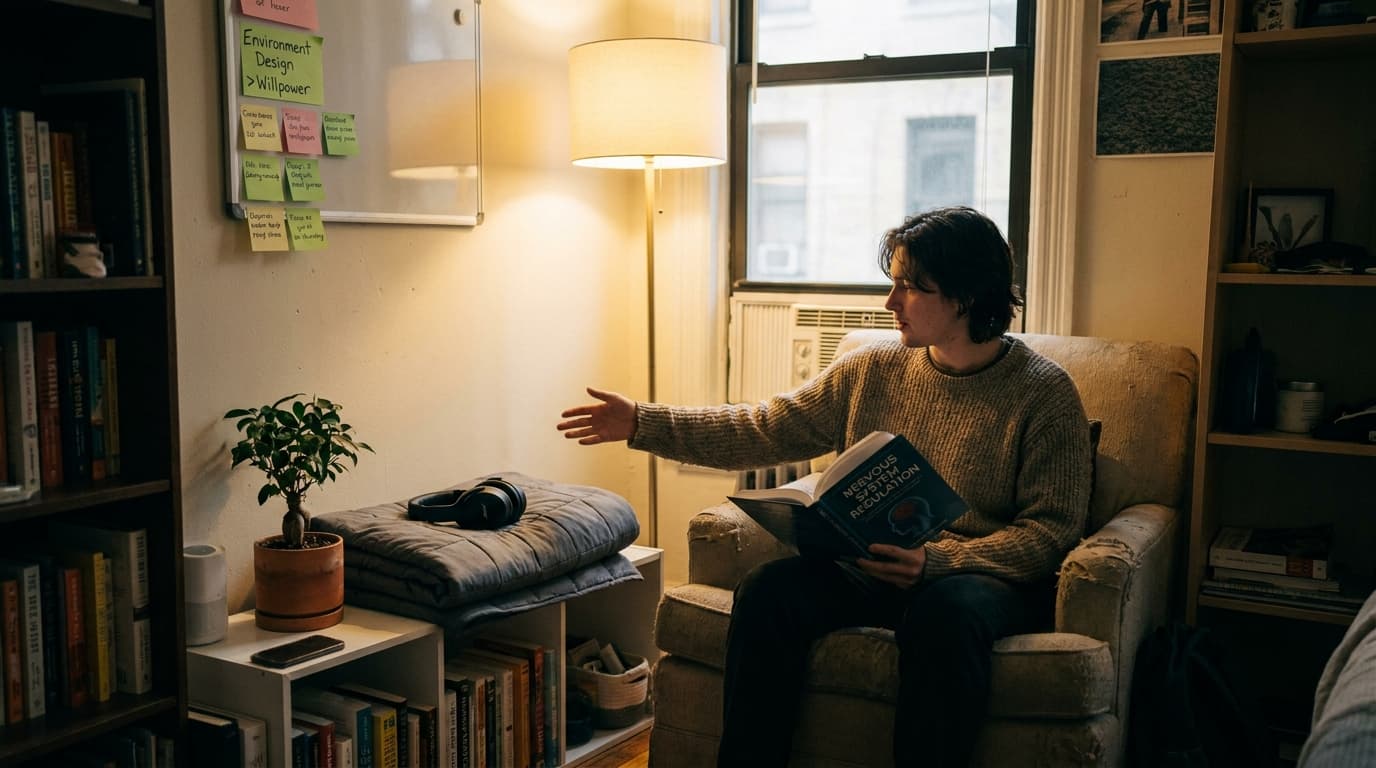
Living in a tight space means your senses are always "on." There is no separate room to escape to when the fridge hums or the street lights bleed through the curtains. This constant input keeps your nervous system in a state of low-level alertness, which drains your cognitive battery before you even start your day. When your environment is cluttered with sensory noise, your brain struggles to distinguish between a place of rest and a place of high performance.
You can counteract this by using small environmental cues to signal safety to your brain. This is a practical application of vagus nerve signaling, where physical actions tell your body it is okay to relax. By changing the lighting or your immediate routine, you lower the cognitive load required to transition from "work mode" to "rest mode." This is far more effective than trying to use willpower to ignore the distractions around you.
Imagine a freelancer working from a small desk right next to their bed. If they keep the bright overhead lights on all evening, their brain never gets the signal to produce melatonin. But if they switch to a low-wattage lamp at 6:00 PM and spend three minutes on a simple breathing ritual, the physical change in the room acts as a prompt to start winding down. This ritual tells the nervous system that the "threat" of the workday is over.
Digital noise also feels much louder when your bed is only three feet from your workstation. In a studio apartment, your phone is a persistent prompt that demands attention because it is always in your line of sight. If your charger stays on your nightstand, the "ability" part of the B=MAP formula is too high, making it nearly impossible to avoid late-night scrolling that ruins your sleep quality.
Take a person who struggles with mental fatigue in a one-room apartment. By moving their phone charger to the kitchen counter, they create a physical boundary that their floor plan lacks. This "no-scroll zone" helps them actually use the habits they have been reading about instead of just consuming more content. It turns a cramped room into a focused sanctuary by simply increasing the friction of a bad habit.
Setting a "digital sunset" is a simple way to protect your cognitive energy and long-term healthspan. When you decide that screens go off at a certain hour, you are designing your environment to support your brain's need for deep recovery. This ensures you stay sharp and capable, which is the ultimate goal of training for the Centenarian Olympics.
- Use warm lamps instead of overhead "big lights" to signal the end of the workday to your brain.
- Start a 3-minute breathing or mobility ritual to signal safety to the vagus nerve before starting a new task.
- Move your phone charger to the kitchen or a distant shelf to keep the bedroom a dedicated no-scroll zone.
- Set a "digital sunset" time every evening to protect your cognitive energy and improve sleep quality.
- Use physical boundaries like rugs or different lighting to separate your "work zone" from your "recovery zone."
Digital Minimalism for Small Space Living
Digital noise is physically more intrusive in a small apartment because there are no walls to isolate the sound or light of a notification. When your workstation is only arm's length from your bed, your phone becomes a constant prompt that spikes cortisol and prevents the nervous system from entering deep recovery. This makes mindset growth difficult because your brain never truly feels off duty.
Take a person who sets up a charging hub in their bathroom or a far kitchen corner. By increasing the physical friction required to check a text, they protect their bedroom as a sanctuary for sleep and reflection. This shift in choice architecture ensures that the ability to scroll is low when your motivation to rest should be high, which is essential for maintaining long-term healthspan.
- Establish a digital sunset time every evening to protect your cognitive energy.
- Relocate all chargers to a single distant hub to remove the phone from your line of sight.
- Use a traditional alarm clock to eliminate the need for a phone on your nightstand.
- Turn off non-human notifications to reduce unnecessary sensory noise in a cramped room.
Can Your Kitchen Layout Improve Your Gut Health?
Your kitchen layout is the physical choice architecture for your microbiome. Research shows that eating 30 or more different types of plant foods per week is associated with significantly higher microbial diversity. This isn't just about digestion. Roughly 90% of your body's serotonin is produced in the gut. This means your fridge setup directly influences your mood and mental clarity. In a small apartment, your goal is to make diverse plant intake the path of least resistance by changing what you see first.
Imagine opening a cramped studio fridge after a long day. If the first thing you see is a heavy take-out box or a bag of processed bread, your brain defaults to that easy option. But if you've organized your shelves so that pre-washed radishes, colorful berries, and leafy greens are at eye level, you are much more likely to hit your variety goals. This is a classic example of using a prompt to trigger a behavior. By making the plants visible, you increase your ability to eat them without needing a massive surge of willpower.
This strategy is a core part of atomic habits in real life because it removes the cognitive load of deciding what to eat. When you reduce the friction of healthy eating, you protect your long-term healthspan. Higher intake of ultra-processed foods is linked to a 62% higher hazard of all-cause mortality. Moving these items to a hard-to-reach cabinet is a small change with massive stakes.
- Tape a Top 30 checklist to your fridge door to track different plant types throughout the week.
- Store whole plants in clear glass containers at the front of the middle shelf where they are impossible to ignore.
- Prep at least three different vegetables as soon as you get home from the store so they are ready to grab.
- Move ultra-processed snacks to a high, out-of-sight cabinet to reduce the visual prompt to eat them.
Getting Started: The 7-Day Space Sprint
Most habit advice feels like it was written for people with spare rooms or massive home gyms. If you live in a studio, you do not need a renovation; you need a sprint. The 7-Day Space Sprint is about making small, surgical changes to your layout so that your environment does the heavy lifting for you. It is based on the idea that discipline is easier in a room designed for it, which is why we focus on physical prompts over mental grit.
Imagine your goal is to start a morning mobility routine, but your yoga mat is currently buried under a pile of laundry in the back of a closet. On day one of your sprint, you clear off a single shelf or a small patch of floor and name that spot your bliss station. By simply moving that mat to the foot of your bed, you have turned a hidden chore into a physical prompt. You are no longer fighting your apartment; you are using its layout to trigger the behavior you want.
This shift is not just about aesthetics; it is about biology. Recent findings show that about 90% of your body's serotonin is produced in the gut, which highlights how your physical environment, diet, and mood are linked. When you reduce environmental friction, you lower the cognitive load on your brain. This makes it easier to focus on other health goals, like hitting the target of 30 different plant foods a week to boost microbial diversity.
To finish the sprint, use a three-minute ritual to signal safety to your nervous system. This could be simple breathing or light stretching in your new space. By ritualizing the start, you tell your vagus nerve it is time to perform. This small act of choice architecture ensures the path of least resistance is the one that leads directly to your goals.
- Identify three items that cause daily friction and relocate them today.
- Name one specific goal for your 7-day sprint to keep the focus narrow.
- Clear a single surface to serve as a dedicated bliss station for your new habit.
- Stage your tools the night before to reduce morning decision-making fatigue.
- Use a three-minute breathing ritual to signal to your nervous system that it is time to start.
Summary: Design Your Way to Better Habits
Relying on discipline is a losing game because willpower runs out. Environment design is more reliable because it changes your choice architecture, making good habits the path of least resistance. When your space does the heavy lifting, you save mental energy for work instead of the struggle to start.
Your apartment size does not limit your potential for progress. Imagine a studio dweller who turns a single corner into a bliss station with just a floor cushion and a lamp. This small zone signals your brain to focus, helping you find mental clarity despite a cramped floor plan.
- Identify one bliss station to set up today.
- Pick a dedicated spot that makes you want to show up.
- Remove clutter from this area to lower the effort of starting.
- Use a physical prompt like a book or a yoga mat to trigger the habit.
Frequently Asked Questions
You have to focus on the layers of environment that you actually control. Even if you do not own the whole room, you have total power over the two feet of space around your bed or your desk. This is your primary zone, and it is where your design efforts should go.
Try using sensory borders to create a private environment. Noise-canceling headphones act like a digital wall, and a dedicated desk lamp can signal to your brain that it is time to focus. You can also use a portable bliss station, which is just a small tray or bag with your essential tools. When the tray is out, you are in your zone. When it is put away, the space returns to being a shared room. This prevents your goals from clashing with your roommate's lifestyle.
It is often more effective than traditional advice because it does not rely on your memory or your internal drive. For someone with ADHD, executive function can feel like a battery that drains quickly. Environment design acts like an external hard drive for your intentions so you do not have to keep them all in your head.
The goal is to use point-of-performance prompts. This follows the B=MAP model, where behavior happens when you have a prompt at the same time you have the ability to do the task. If you put your gym bag right in front of the door, you are not using willpower to remember to go to the gym. You are simply responding to a physical cue that is already there. This reduces the mental effort needed to get started and helps you bypass the struggle of deciding what to do next.
The most important change is designing your space to increase your ability to follow through without relying on willpower. In a studio, this often starts in the kitchen because your diet sets the tone for your daily energy. For example, research suggests that eating 30 or more different types of plant foods per week is associated with much higher gut health diversity. You can make this easy by keeping various seeds and nuts in clear jars on your counter so they are the first thing you see.
When you make the healthy choice the most visible choice, you stop fighting yourself. This works because you are changing the choice architecture of your room to favor your goals. By setting up these small prompts, you spend less mental energy on decisions and more on actually doing the things that make you feel good.
You can prevent clutter by using choice architecture to make it harder for random items to land there. If your bliss station is a small table, place a single object like a plant or a framed photo in the center when you are not using it. This leaves no room for mail or keys to pile up because the space already has a dedicated purpose.
Here is the thing: you can also use a short ritual to protect your focus. Before you start your session, take two minutes to clear the immediate area and breathe. This signals to your nervous system that you are moving from daily chores into a time for growth. It is a simple way to reset your environment and keep your attention on your goal instead of the surrounding mess.
Conclusion
Living in a small apartment can feel like a constraint, but it is actually your biggest advantage for building better habits. When your kitchen, bed, and desk are only steps apart, you do not need more willpower to stay on track. You just need to arrange those few square feet so the right choice is the easiest one to make. By reducing friction and setting up dedicated zones like a bliss station, you stop fighting your surroundings and start letting them do the heavy lifting for you.
The bottom line is that your space should serve your goals rather than clutter your mind. You do not need a massive home renovation to see a difference. Your next move could be as simple as moving your phone charger out of the bedroom or clearing one specific shelf for your morning ritual. These small shifts in choice architecture create a home that supports your nervous system instead of draining it.
Focus on making one small change today that makes a good habit feel like the path of least resistance. Environment design beats willpower every time because it turns your home into a partner in your progress. You have full control over your immediate world, so make it work for you.

Send it to someone who should read it next.
About the author

ScoreRead Editorial Team
Editorial Team
Every article on ScoreRead is researched, written, and edited by our editorial team before publishing, so the ideas we cover stay accurate, clear, and genuinely useful.
View all articles