Best Books for Overthinking and Mental Clarity: How to Improve Focus and Discipline
Finding the best books for overthinking and mental clarity, how to improve focus through reading techniques, cognitive biases books for better decision making, what to read when feeling unmotivated and...

ScoreRead Editorial Team
Editorial Team

Best Books for Overthinking and Mental Clarity: How to Improve Focus and Discipline
Finding the best books for overthinking and mental clarity, how to improve focus through reading techniques, cognitive biases books for better decision making, what to read when feeling unmotivated and needing discipline, the power of now summary and real-life application is the best way to stop a mental spiral.
A racing mind often happens because we have too many choices and not enough mental models to filter them.
We'll cover which titles build discipline and how you can apply these lessons to stay grounded and productive every day.
Table of Contents
- Why Overthinking Happens and How the Right Books Help
- How to Improve Focus Through Reading Techniques
- Cognitive Biases Books for Better Decision Making
- What to Read When Feeling Unmotivated and Needing Discipline
- The Power of Now Summary and Real-Life Application
- Frequently Asked Questions
- Conclusion
Why Overthinking Happens and How the Right Books Help
Overthinking happens when your brain lacks the right filters to process the noise of daily life. It is like trying to run modern software on an old computer.
Eventually, the system freezes up because it is overloaded with data it does not know how to sort. Reading books that focus on cognitive biases helps you install those filters so you can see which thoughts are actually useful.
Take a professional who is stuck on a project and keeps adding more features just because they already spent months on the initial draft. This is a classic example of the Sunk Cost Fallacy.
In his book, The Art of Thinking Clearly, Rolf Dobelli identifies exactly 99 of these common thinking errors that make us overcomplicate simple life situations. By learning to name these patterns, you stop being a victim of them and start making cleaner decisions.
This mental clutter often gets worse when we have too many options, a concept known as the paradox of choice. Barry Schwartz’s research shows that while we think more choices make us happy, they actually lead to mental fatigue and regret.
When you are faced with fifty different types of cereal or five different career paths, your brain works overtime to compare every tiny detail. This leaves you exhausted and paralyzed by what if scenarios, wasting your willpower on things that do not actually matter.
One way to fix this fatigue is through pre-deciding. By setting rules for yourself ahead of time, you remove the need to think about small details throughout the day.
For example, if you decide on Sunday what you will wear all week, you save that mental energy for more important tasks. You can see how this works in practice by exploring stoicism books for discipline and mental clarity.
To truly improve your focus, you have to be selective about what you consume. Francis Bacon suggested that only a few books should be chewed and digested thoroughly to gain true value.
Deeply engaging with these ideas helps you build a stronger mental foundation. You can find more on how book insights and the best books for finding purpose can shift your perspective and help you stop the mental spiral.
Key insights:
- Identify one specific thinking error like the Sunk Cost Fallacy this week and notice when you are doing it.
- Use pre-deciding for small daily choices to save your willpower for things that actually matter.
- Limit your options to three or fewer when making a quick decision to avoid the exhaustion of the choice paradox.
- Set a 20-minute timer for deep reading with your phone in another room to rebuild your attention span.
The Paradox of Choice and Mental Fatigue
Too many options feel like freedom, but they actually create a mental trap. When you face endless choices, your brain burns through willpower just to make a simple decision. This fatigue makes it nearly impossible to maintain the discipline needed for deep work.
Imagine a freelancer who starts their day without a plan. They spend two hours deciding which project is urgent, what music to play, and where to sit. By the time they start, they are already exhausted. This is why Rolf Dobelli identifies exactly 99 thinking errors in his work. We often overcomplicate our lives because we don't recognize these patterns. You can find better ways to manage this in stoicism books for discipline and mental clarity.
Key insights:
- Pre-decide your morning routine the night before to save willpower for big tasks.
- Limit your options to three or fewer when making quick decisions to avoid regret.
- Use best books for building discipline and consistency to set firm rules for your work day.
- Commit to a choice immediately to stop the mental drain of what-if thinking.
How to Improve Focus Through Reading Techniques
Training your brain to concentrate starts with how you treat a single page. If you spend your day scrolling through headlines, you are essentially teaching your mind to be restless. Using specific how to improve focus through reading techniques can turn a simple book into a gym for your attention span. It works because books demand a linear, sustained effort that digital scrolling usually destroys.
You don't need hours of silence to see results. Even short bursts of focused reading can help rebuild the neural pathways needed for deep concentration. It is about quality over quantity, which is why how book insights change lives is often more about the depth of your focus than the number of pages you turn.
Imagine you are sitting down with a dense book like Ralph Ellison's Invisible Man, which was published in 1952 and still offers deep insights into social identity. Instead of racing to the finish line just to say you are done, you treat it like a heavy meal. As Francis Bacon famously suggested, "Some books should be tasted, some devoured, but only a few should be chewed and digested thoroughly." This means stopping after a paragraph to think about how it applies to your own life before moving on.
This slow approach creates a flow state, which is a psychological state where you become fully immersed in what you are doing. When you stop rushing, your brain stops looking for the next distraction. You can learn more about creating these habits in our guide on the best books for building discipline and consistency. Darius Foroux’s curated reading list emphasizes that high-quality recommendations are better than chasing every new bestseller.
Key insights:
- Set a 20-minute deep work timer for reading to build your mental endurance.
- Put your phone in another room to remove the temptation of instant notifications.
- Highlight or underline sentences that make you stop and think to engage your logical brain.
- Ask yourself one question after every chapter: "How does this change my current perspective?"
Cognitive Biases Books for Better Decision Making
We all make the same mental blunders over and over because our brains prefer shortcuts. These shortcuts, or cognitive biases, were helpful when we were dodging predators, but they often lead to poor choices in a modern office or home. Reading the right books helps you spot these glitches before they ruin your day. If you want to stop the cycle of regret, you have to learn how your mind actually works. You can explore more about this in our guide to compare and apply decision making books best reads for procrastination and mindset growth. This isn't just about intelligence. It is about awareness.
Imagine you are at a car dealership and the salesperson offers a "limited time" discount that expires in an hour. Your "System 1" brain, as Daniel Kahneman calls it, screams at you to take the deal because it hates missing out. This is a classic cognitive trap. Kahneman, who has been studying this since 1961, explains that this fast-thinking part of our brain is often wrong. It is impulsive and emotional. By contrast, your "System 2" brain is slow and logical, but it is lazy. It takes effort to wake it up.
Another great resource is Rolf Dobelli, who identifies exactly 99 common thinking errors that trip us up. These errors range from the "sunk cost fallacy" to simple social distortions that cloud our judgment. When you understand these patterns, you stop being a victim of your own biology. It is about slowing down and giving your logical mind a chance to catch up with your gut reactions. This shift is a key part of finding stoicism books for discipline and mental clarity a practical guide that offer timeless wisdom for modern problems.
Key insights:
- Wait 24 hours before making any major purchase or life change to allow your logical System 2 to engage.
- Limit your options to three choices or fewer because having too many choices is mentally exhausting and leads to worse decisions.
- Pick one specific bias from Dobelli’s list each week and try to notice when you are doing it in real time.
- Practice conscious breathing for a few cycles when you feel an impulsive urge to buy or react to a stressful situation.
What to Read When Feeling Unmotivated and Needing Discipline
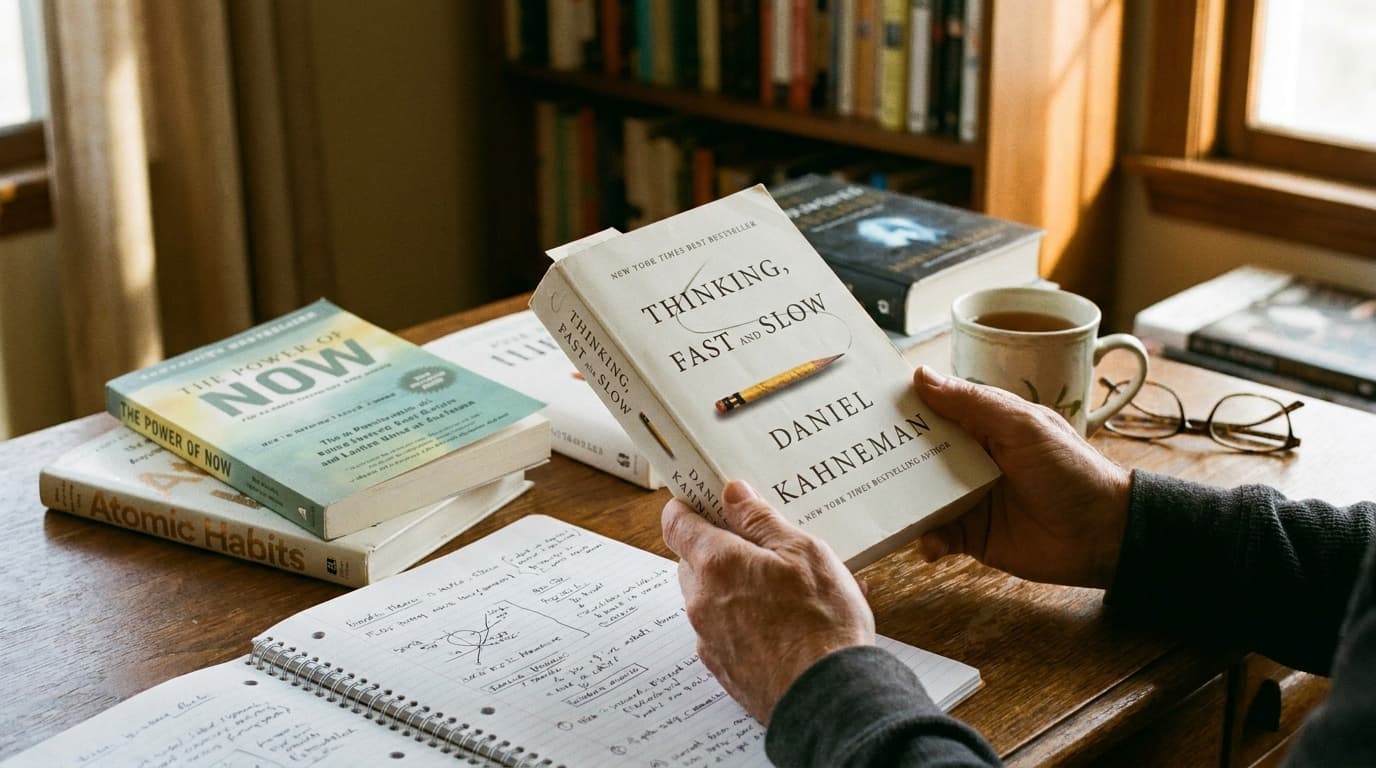
Getting back on track when you feel stuck isn't about finding a magic burst of inspiration. Most people wait for motivation to strike before they start, but it actually works the other way around. Action creates the motivation. If you feel lazy, your brain is likely stuck in a low-energy loop that needs a jolt to break.
Reading about the science of behavior can help you stop blaming your personality for a temporary lack of drive. Books that focus on the link between your body and your brain are often more effective than standard manuals. They show you that discipline is a physiological state you can trigger. This is why best books for building discipline and consistency an idea breakdown often focus on habits rather than willpower.
Imagine a professional who has been staring at a project for hours, feeling guilty and distracted. They might try to force themselves to sit there, but their focus is gone. Instead of white-knuckling it, they pick up John Ratey’s book Spark and learn that physical movement directly sparks the mental discipline needed to work. They go for a ten-minute brisk walk. By the time they return, their brain has literally changed its chemistry, making it easier to finally finish the task.
Darius Foroux often notes that ignorance costs you more than you'll ever know. This applies to your own biology. If you don't understand that your brain needs movement to focus, you'll keep fighting a losing battle against yourself. Learning these basic rules for your mind is the fastest way to return to a flow state.
Key insights:
- Use the 5-minute rule by committing to just five minutes of reading or movement to break the seal of procrastination.
- Check out this idea breakdown how to build self discipline through reading and what to read when feeling unmotivated and lazy for titles that match your current energy level.
- Commit to chewing and digesting one high-quality page of a book like Spark instead of skimming through dozens of articles.
- Notice when you are waiting for a feeling to start work and replace that wait with a small, physical action like standing up or stretching.
The Power of Now Summary and Real-Life Application
Applying Eckhart Tolle’s philosophy to a busy modern schedule doesn’t require sitting on a meditation cushion for hours. It is about finding tiny pockets of awareness in the middle of your daily noise. When you focus on the present moment, you effectively cut off the fuel supply to the mental loops that drive overthinking and anxiety.
This shift helps you move from a state of constant reaction to one of calm, steady observation. By staying present, you chew and digest your current experience instead of just skimming through your day like a social media feed. This depth of engagement creates true mental clarity and allows your brain to settle into a flow state where work feels natural.
Physical movement also plays a huge role in this grounding process. As John Ratey explains in his research, exercise acts as a direct catalyst for mental productivity because it forces you out of your head and into your body. When you combine Tolle’s presence with physical activity, you create a powerful defense against the intrusive thoughts that often derail your discipline.
Understanding our evolutionary history helps us realize why our brains are wired to worry about the future. Our ancestors survived by predicting threats, but in a modern office, that same instinct just creates unnecessary stress. By intentionally choosing the now, you are essentially retraining your biological hardware to function better in a world it was not originally designed for.
Imagine you are stuck in a long line at the grocery store or trapped in a stressful meeting that seems to be going nowhere. Instead of checking your phone or rehearsing an argument in your head, you focus on the sensation of your inner body. You notice the weight of your arms or the rhythm of your heart, which keeps you from spiraling into the future and preserves your energy.
Key insights:
- Practice conscious breathing for three full cycles whenever you feel your thoughts starting to spiral into the future.
- Use inner body awareness during mundane tasks like waiting in line or sitting in traffic to stay grounded.
- Engage in short bursts of physical movement to snap your brain out of a mental loop and back into the present.
- Limit your daily choices to reduce decision fatigue and keep your mental focus sharp for high-priority tasks.
Frequently Asked Questions
If you feel stuck in your head, you should definitely check out The Art of Thinking Clearly by Rolf Dobelli. It is helpful because it identifies exactly 99 common thinking errors that we all fall for. Instead of just telling you to stop overthinking, it shows you the specific biases and social distortions that are messing with your head in the first place.
Here is the thing: once you see these patterns, it gets much easier to spot them in real life. You also want to keep in mind that having too many choices is actually mentally exhausting. Limiting your options usually leads to much better mental clarity and less stress, which is a big part of why overthinking happens.
Improving your focus starts with changing how you approach your daily rituals. A big insight most people miss is that physical movement is a direct catalyst for mental productivity, not just physical health. Exercise impacts your focus more than you might think, so moving your body can actually help your brain settle down and do the work.
If you find yourself skimming everything, try the chewing and digesting method. As Francis Bacon famously said, some books should be tasted, but only a few should be chewed and digested thoroughly. Instead of rushing through ten books, pick one high-quality read and really sit with it. This helps train your brain to stay with a single thought for longer periods without needing a constant hit of something new.
It definitely can, but here is the thing: you have to do more than just skim through the pages. Real change happens when you treat a book like a manual for your life. As Francis Bacon once said, only a few books should be chewed and digested thoroughly. When you find the right ones, they teach you how to automate your habits so you do not have to rely on willpower alone all the time.
Reading about habit formation helps you build routines that make discipline feel like a natural part of your day instead of a chore. Plus, investing in your education through books is always better than buying gadgets, because as Darius Foroux mentions, ignorance costs you more than you will ever know.
Applying this at work is all about finding your flow. When your inbox is overflowing and your phone won't stop ringing, the goal is to focus entirely on the one task right in front of you. This is what psychologists call a flow state, and it changes how you feel about your work and life satisfaction.
You can also try limiting your choices. Having too many options is mentally exhausting, so narrowing your focus to just one or two big goals for the day provides the mental clarity you need to stay calm. It is about being present with your current task rather than worrying about the fifty other things on your to-do list.
Conclusion
So where does this leave us? It shows that finding the best books for overthinking and mental clarity is not about reading as many pages as possible. It is about picking the right mental models to stop the noise in your head. When you learn about cognitive biases books for better decision making, you start to see the loops before you get stuck in them.
The real shift happens when you stop just collecting facts and start building discipline. Whether you are looking for what to read when feeling unmotivated and needing discipline or you want a the power of now summary and real-life application, the goal is the same. You want to move from mental fatigue to clear focus.
Try picking just one title from this list today. Learning how to improve focus through reading techniques is a practice, not a destination, and you already have the tools to start. Grab a book, find a quiet spot with your cat, and let the clarity begin.

Send it to someone who should read it next.
About the author

ScoreRead Editorial Team
Editorial Team
Every article on ScoreRead is researched, written, and edited by our editorial team before publishing, so the ideas we cover stay accurate, clear, and genuinely useful.
View all articles