How to Structure a Workday Around Your Actual Energy, Not the Clock
You can boost your productivity by 71% when you learn how to structure a workday around your actual energy, not the clock. Instead of forcing a standard 9 to 5,...

ScoreRead Editorial Team
Editorial Team
How to Structure a Workday Around Your Actual Energy, Not the Clock
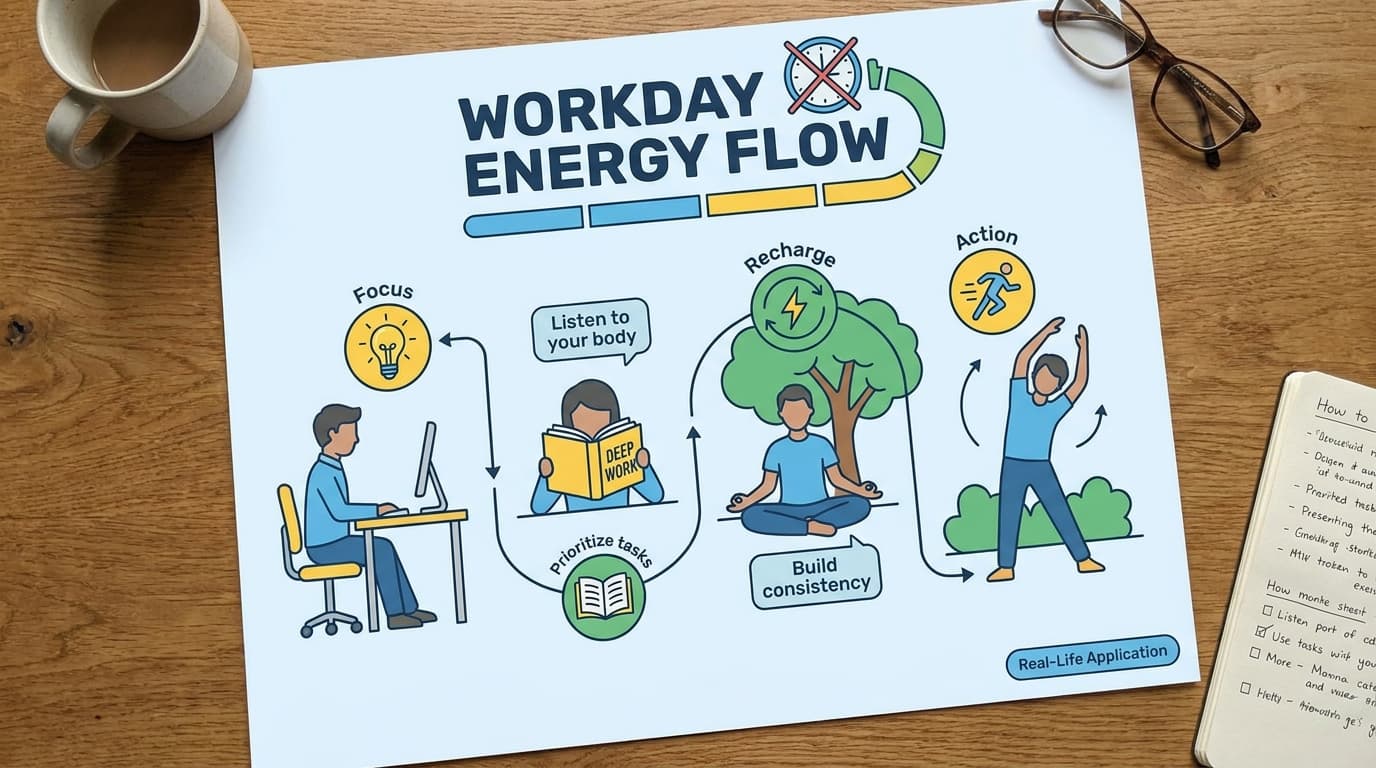
You can boost your productivity by 71% when you learn how to structure a workday around your actual energy, not the clock. Instead of forcing a standard 9 to 5, you should treat your work like an athlete by matching hard tasks to your biological prime time.
Time is a fixed resource, but your energy is renewable. Most people sit at a desk for eight hours but only produce two hours of quality work because they are fighting their natural rhythms.
You will learn how to map your energy levels and use rest cycles to stay focused without the afternoon crash.
Table of Contents
- How to Structure a Workday Around Your Actual Energy, Not the Clock
- Why Energy Management Beats the Traditional 9-to-5 Schedule
- How to Map Your Biological Prime Time in 3 Simple Days
- Working with Your Body: The Power of Ultradian Rhythms
- Matching Your Tasks to Your Unique Chronotype
- Why 'Athletic' Recovery Periods Are Your Best Productivity Tool
- Common Questions About Energy-Based Scheduling
- Frequently Asked Questions
- Conclusion
Stop treating your time as the primary resource and start managing your biological energy instead. The old factory model assumes we should produce at a steady rate for eight hours, but humans actually function through performance cycles. A study on energy management found that 71% of participants saw a major productivity boost when they focused on their internal battery rather than the clock.
Consider a developer who hits a wall every afternoon at 3:00 p.m. but keeps grinding because the schedule says so. By the time they finish, they have spent two hours on a task that should take thirty minutes. Using mental clarity techniques to recognize these dips allows you to step away for a recovery cycle instead of wasting time in a fog.
The shift from time-tracking to energy-mapping is about working with your body rather than against it. When you align your hardest tasks with your natural peaks, you get more done in less time and avoid the burnout that comes from constant pushing.
Key insights:
- Rate your focus from 1 to 10 every hour for three days to identify your Biological Prime Time.
- Block off your highest-rated Green Zone hours for deep, complex work that requires total concentration.
- Shift low-energy tasks like email or filing to your Red Zone when your brain naturally needs a break.
- Follow the 52-17 rule by working for 52 minutes and resting for 17 to keep your cortisol levels stable.
Why Energy Management Beats the Traditional 9-to-5 Schedule
Traditional time management often fails because it treats humans like machines. We assume we can produce at a steady, high-quality rate for eight hours straight just because the clock says it is a workday. In reality, time is a fixed resource of 24 hours, but energy is a flexible resource that you can actually expand through intentional recovery.
Think of a developer sitting at their desk from 9:00 a.m. to 5:00 p.m. They might spend four hours staring at a screen or dragging through simple emails because they hit a mental wall by noon. Even though they worked a full shift, they only produced two hours of high-quality code. This happens because they are managing the clock instead of their internal battery.
Peter Drucker famously argued that effective people start with their time, not their tasks. To thrive today, you should apply that logic to your energy levels. Instead of asking what time it is, ask how much fuel you have left in your tank before starting a difficult project.
While time is a zero-sum game where every minute spent is gone forever, energy is renewable. Research into energy modules like the mind, body, and spirit shows that 71% of people see a massive boost in performance when they focus on recovery. You cannot create more hours, but you can bring more intensity to the hours you already have.
Productivity is most effective as a series of sprints rather than a flat line of effort. Our bodies move through ultradian rhythms, which are natural energy cycles lasting between 90 and 120 minutes. Pushing past these cycles without a break leads to a spike in cortisol and a drop in focus.
High-productivity work is similar to athletics, where cycles of intense effort followed by rest produce the best results. When you treat your workday like a marathon of sprints, you avoid the 'gray zone' of being half-focused and half-fatigued all afternoon.
Key insights:
- Adopt Peter Drucker’s philosophy by auditing your internal energy battery before you commit to a deep-work task.
- Identify one low-value task, such as checking non-urgent notifications, and cut it entirely to save your mental fuel for creative work.
- Use the 52-17 rule by working for 52 minutes and then taking a 17-minute break to reset your brain health.
- Schedule your most demanding analytical tasks during your peak energy windows rather than just doing them first thing in the morning.
The Finite Nature of Time vs. the Renewable Nature of Energy
Time is a hard limit. You only get 1,440 minutes a day, and once they are gone, they are gone. But energy is renewable. Research into energy modules shows that 71% of people see a major boost in performance when they manage their internal battery instead of just watching the clock.
Imagine a designer who treats their day like a series of sprints rather than a flat line. They map their day into zones: Green for deep work and Red for rest. Instead of grinding through a six-hour block, they tackle a complex layout during their 9:00 a.m. peak and save emails for their 3:00 p.m. lull. They are not working more hours, but they are bringing much higher intensity to the time they have.
Key insights:
- Track your focus on a scale of 1-10 every hour for three days to find your peak windows.
- Cut one low-value task, like checking non-essential notifications, to save mental fuel for deep work.
- Schedule hardest tasks between 9:00 a.m. and 10:30 a.m. when cortisol and caffeine levels align.
- Follow the 52-17 rule by working for 52 minutes and resting for 17 to keep your brain fresh.
How to Map Your Biological Prime Time in 3 Simple Days
Finding your peak energy isn't about guessing. It's about data. You can identify your highest focus periods by running a simple three-day audit of your internal battery. Instead of forcing yourself to be productive at 10:00 a.m. just because the clock says so, you look for your Green Zone. This is the window where your brain naturally enters a state of flow and produces your best work.
Our bodies follow ultradian rhythms, which are natural energy cycles that last between 90 and 120 minutes. Most people try to push through these cycles with caffeine. But research into energy management suggests that working with these rhythms is far more effective. When you understand your personal peaks, you stop fighting against your biology and start using it to your advantage. This shift is how you learn to structure a workday around your actual energy, not the clock.
Imagine a project manager named Leo who feels like he is failing because his afternoon meetings leave him drained. He decides to track his focus every sixty minutes for three days. By Wednesday, he sees a clear pattern. He hits a 10 at 8:30 a.m. but drops to a 3 by 2:00 p.m. Instead of reaching for a third cup of coffee, he realizes he can use the best books for building discipline to stick to a new plan. He moves his deep-thinking tasks to the morning and saves the low-energy admin for his afternoon slump. This realization helps him stop overthinking and procrastination because he finally knows when he is most capable of solving hard problems.
This process helps you build the Emotional Intelligence Books For Adult Self Regulation skills needed to manage a flexible schedule. Once you have your data, you can create a color-coded map that dictates your day. Green is for your hardest projects, yellow is for administrative tasks, and red is for pure recovery. This simple audit is the first step to structure a workday around your actual energy, not the clock. It turns your schedule from a rigid list of tasks into a living document that respects your body.
Key insights:
- Track your focus levels on a scale of 1-10 every hour for three consecutive days to find your natural patterns.
- Label your highest-rated hours as your Green Zone and block them off for deep, uninterrupted work.
- Assign administrative tasks like emails and scheduling to your Yellow Zone when your focus is moderate.
- Protect your Red Zone for rest or physical movement to recharge your mental battery for the next cycle.
- Schedule your coffee intake for between 9:00 a.m. and 10:30 a.m. when natural cortisol levels are lower to maximize alertness.
Working with Your Body: The Power of Ultradian Rhythms
The ideal work session is not an eight-hour marathon. It is actually a series of sprints that last between 90 and 120 minutes. This is because your body follows natural energy cycles called ultradian rhythms. These cycles dictate how long you can stay focused before your brain needs a reset. Research from Atlassian shows that 71% of people who focus on managing energy modules like the mind and body see a huge boost in performance.
Think of your brain like a battery that needs regular recharging. When you ignore these rhythms, you end up staring at a screen without actually producing anything. Working in alignment with your biology keeps your stress hormones low and your focus sharp. This is especially useful for the 37% of people who now work from home and have more control over their daily schedules. Managing energy is more effective than managing time because time is finite, but your energy can be renewed throughout the day.
Imagine a software developer named Marcus who used to grind through his morning without a single break. By 2:00 p.m., he felt like his brain was made of fog. He would try to force himself to code, but he mostly just made mistakes that he had to fix later. Now, he uses 90-minute Power Hours for his most complex tasks. After each session, he takes a 20-minute Disconnection break where he leaves his desk and stays away from all screens. This approach treats his work like an athletic event.
Marcus also uses emotional intelligence books for adult self regulation to recognize when his body is signaling for a break. Instead of reaching for more caffeine, he realizes that a quick walk is what his brain actually needs. This shift stopped him from feeling like a machine and started making him feel like an elite performer. He found that by respecting his body, he actually got more done in fewer hours. As experts Tony Schwartz and Jim Loehr point out, high-productivity work is like sports because cycles of intense effort followed by recovery create the best results.
Working this way requires a shift in mindset. You have to stop viewing rest as a reward for finishing work and start seeing it as a requirement for doing work. When you time your sprints, you give your brain permission to go all out because it knows a break is coming. This creates a sustainable rhythm that prevents the mid-afternoon crash most workers accept as normal.
Key insights:
- Use a timer to enforce the 52-17 rule, which involves working for 52 minutes followed by 17 minutes of rest.
- Step away from your desk during breaks to physically change your environment and lower your cortisol levels.
- Schedule your hardest tasks during your first 90-minute block of the day when your mental battery is at its peak.
- Check out the best books for building discipline to help you stay committed to these new timing habits.
- Avoid checking your phone or emails during recovery periods so your brain can fully disengage and reset.
Matching Your Tasks to Your Unique Chronotype

Adjusting your schedule based on whether you are a morning person or a late riser is about working with your biology instead of fighting it. Most people assume they need to be on from 9 to 5, but our internal clocks do not follow a corporate calendar. Since 37% of jobs can now be done from home, many of us have the freedom to ditch the standard clock and focus on our actual energy levels.
If you are a night owl, forcing yourself to do deep analytical work at 8:00 a.m. is a recipe for mistakes and burnout. Instead, identify your Biological Prime Time, which is the window where your focus naturally hits a 9 or 10 on a scale of 10. Research shows that managing these energy modules has a positive impact on performance for 71% of people.
Imagine an early bird who usually crashes by late afternoon. Instead of trying to power through a complex spreadsheet at 6:00 p.m., they should use that slight mental fatigue to their advantage. When your inhibitions are lower because you are a bit tired, your brain actually becomes more creative. This is the perfect time for a brainstorming session where unusual ideas can flow without your inner critic shutting them down.
When you learn how to structure a workday around your actual energy, not the clock, you stop being a slave to the 9-to-5 model. This logic applies to your morning routine too. Many people reach for coffee the second they wake up, but that might be a waste of a natural energy boost. Your body already produces cortisol to wake you up at 7:00 a.m., so adding caffeine then is like pouring water into a full glass.
To get the most out of your caffeine, wait until your natural cortisol levels start to dip. The sweet spot is usually between 9:00 a.m. and 10:30 a.m. This ensures the stimulant hits right when you actually need it, rather than overlapping with your body's own wake-up call. If you need a lift before then, try simple hydration because water is a powerful non-stimulant energy source that keeps your brain cells firing without the later crash.
Learning these rhythms is part of building discipline and consistency. It takes practice to stop yourself from doing busy work like emails during your peak focus hours. Save those low-energy tasks for your Lull periods when your brain needs a break from heavy lifting. Human bodies naturally move through ultradian rhythms, which are energy cycles lasting about 90 to 120 minutes.
If you try to work through these cycles without a break, your productivity will eventually tank. Think of your workday as a series of sprints rather than one long, exhausting haul. By timing your hardest tasks to these 90-minute Power Hours, you can get more done in less time while keeping your mental battery charged.
Key insights:
- Move your most difficult analytical tasks to your peak focus window to maximize accuracy and speed.
- Schedule creative brainstorming for periods when you feel slightly fatigued to lower your mental inhibitions and spark new ideas.
- Batch your emails and administrative tasks for your afternoon Lull or recovery periods when your focus is naturally lower.
- Delay your first cup of coffee until at least 9:00 a.m. to avoid wasting your natural morning cortisol spike.
- Drink a full glass of water every time you finish a 90-minute work cycle to maintain energy without relying on stimulants.
Timing Your Caffeine for Maximum Impact
Drinking coffee the moment you wake up is often a waste of your natural chemistry. Your body releases cortisol around 7:00 a.m. to jumpstart your system, so adding caffeine then is like pouring water into a full glass. Productivity research from Syracuse University shows the stimulant is far more effective once those levels start to dip.
Imagine a worker who chugs espresso at sunrise only to crash by mid-morning. If they switched to water first thing, they would stay hydrated without the early jitters. By delaying that first cup until 9:30 a.m., they align the caffeine with their actual needs. This intentionality helps in building discipline and consistency throughout the workday.
Key insights:
- Delay your first cup of coffee until the 9:00 a.m. to 10:30 a.m. window.
- Reach for a large glass of water first thing to provide a non-stimulant energy boost.
- Monitor focus levels for three days to find your personal Green Zone for deep work.
Why 'Athletic' Recovery Periods Are Your Best Productivity Tool
High performance isn't about grinding for eight hours straight. It is about understanding that your brain is like a muscle that needs intentional breaks to grow stronger. Tony Schwartz and Jim Loehr point out that knowledge work is actually similar to professional athletics. In sports, cycles of intense effort followed by recovery are what create training gains. If you skip the rest, you aren't being more productive; you are just draining your battery until you hit a wall.
Think about a professional sprinter. They don't try to maintain a world-record pace for an entire afternoon. They sprint, then they rest, then they review their form. Now look at a typical office worker. We often try to sprint through spreadsheets and meetings from 9:00 a.m. to 5:00 p.m. without stopping. By the time 3:00 p.m. rolls around, the quality of work drops significantly. This happens because the mental training gain only occurs when you allow the mind to reset and process the effort.
This shift in mindset is backed by data. Research into energy management shows that focusing on your mind, body, and emotions has a huge payoff. In one study, 71% of participants saw a substantial positive impact on their performance when they prioritized energy over the clock. To do this, track your focus on a scale of 1 to 10 every hour for three days. Once you see your natural dips, you can schedule your athletic recovery periods exactly when your brain needs them most.
Key insights:
- Implement one recovery sprint mid-day, such as a fifteen-minute walk without your phone to clear mental clutter.
- Step away from your desk as soon as you feel your focus dipping rather than forcing yourself to stare at the screen.
- Schedule a brief breathing exercise between your most demanding projects to keep your cortisol levels in check.
- Treat your lunch break as a true disconnection period where you avoid checking emails or work messages entirely.
- Change your physical environment during breaks to signal to your brain that the sprint phase is temporarily over.
Common Questions About Energy-Based Scheduling
Many people worry that energy-based scheduling is a luxury for the self-employed. But even if you have a boss or work in a busy office, you can still reclaim your focus. Research shows that 71% of people see a major boost in productivity when they focus on energy renewal rather than just watching the clock. It is about identifying the small windows where you have autonomy and using them for your most demanding tasks.
To start, track your focus on a scale of 1 to 10 every hour for three days to reveal your Biological Prime Time. For example, an early bird might find their Green Zone is 8:00 a.m. to 11:00 a.m. They should schedule deep work then, save admin for their 2:00 p.m. Yellow Zone, and use their 4:00 p.m. Red Zone for low-stakes emails or a walk. This data gives you the leverage to explain to a manager why you are more effective doing specific tasks at certain times.
In a shared office, use physical cues like headphones to protect these zones from interruptions. Combine this with smart nutrition to avoid the afternoon slump. Matching your meals to your self-regulation and deep work needs prevents the blood sugar crashes that often derail a well-planned schedule. Even small changes, like timing your caffeine for when cortisol naturally dips, can make a massive difference in your output.
Key insights:
- Map your energy by logging your focus level every hour for three days to find your peak Green Zone.
- Negotiate no-meeting blocks with your boss during your highest energy hours to protect your most productive time.
- Time your coffee for 9:30 a.m. when cortisol levels naturally drop to get the most effective boost without the crash.
- Wear headphones or use a digital status to signal deep work periods to coworkers in a shared environment.
- Swap heavy lunches for light, protein-heavy snacks to maintain a steady energy plateau throughout the afternoon.
Frequently Asked Questions
Even if you cannot change when you clock in, you often have more control over your task list than you think. The trick is to stop treating every hour of the workday as equal. For example, since emails sent between 6:00 a.m. and 9:00 a.m. are more likely to get a response, you can knock those out early while your brain is still warming up, saving your peak focus for later.
It also helps to look at your caffeine habits. Many people drink coffee as soon as they sit down, but coffee is actually most effective between 9:00 a.m. and 10:30 a.m. when your natural cortisol levels start to drop. By timing your breaks and caffeine to match these internal dips, you can stay productive even in a rigid office environment without burning out by mid-afternoon.
Think of your circadian rhythm as the 'macro' cycle and ultradian rhythms as the 'micro' cycles. Your circadian rhythm is the 24-hour internal clock that dictates when you feel awake or sleepy based on light. On the other hand, human bodies move through ultradian rhythms which are much shorter energy cycles lasting between 90 and 120 minutes.
The reason this matters is that your 24-hour clock tells you when to work, but your ultradian cycles tell you when to pause. If you ignore the end of an ultradian cycle and keep pushing, your body enters a stress response to keep you alert. This is why you might feel exhausted but unable to sleep at night - you've essentially overridden your body's short-term recovery signals so many times that your long-term sleep cycle gets thrown off balance.
It is often a combination of your body’s natural rhythm and the timing of your morning caffeine. While most people reach for a cup the second they wake up, coffee is actually most effective between 9:00 a.m. and 10:30 a.m. when your natural cortisol levels start to drop. If you fuel up too early, you are essentially setting yourself up for a harder crash right around 3:00 p.m. when your focus naturally dips.
Here is the thing: that 3:00 p.m. slump is what energy experts call your 'Red Zone.' It usually marks the end of a major ultradian cycle where your brain has used up its immediate chemical fuel. Instead of fighting it with more sugar or caffeine, the best fix is a 20-minute 'disconnection' break where you physically leave your desk. It sounds counterintuitive to stop working when you feel behind, but it is the only way to reset your system for the final stretch of the day.
Actually, being a little tired is often better for raw brainstorming. When you are fully alert, your brain is excellent at filtering out 'weird' or 'unrealistic' ideas, which is exactly what you do not want when you are trying to be original. When you are slightly fatigued, your mental inhibitions drop, allowing your mind to make more unusual connections that you might have dismissed earlier in the day.
For example, if you are an early bird, you might find your best ideas come around 6:00 p.m. when your analytical focus is starting to blur. It is all about using your 'off' hours for thinking outside the box and saving your peak focus for tasks that require precision and logic. Research into energy management shows that 71% of people see a positive impact on performance when they stop forcing every task into the same 9-to-5 window.
Conclusion
The bottom line is that your output has less to do with the hours spent at a desk and everything to do with the quality of energy you bring to them. When you stop fighting your natural rhythms and start working with your biological prime time, you move away from the exhaustion of the 9-to-5 grind. Your brain is not a machine meant to run at full speed for eight hours straight.
Consider starting a three-day energy audit tomorrow morning. Track your focus on a scale of one to ten every hour to find your peak focus window. If you find a spike at 10:00 a.m., use that time for your hardest analytical tasks and save the low-energy admin work for your natural afternoon slump. This simple shift ensures you are using your best fuel for your most important goals.
Learning how to structure a workday around your actual energy, not the clock, is the best way to prevent burnout while staying productive. Treat your focus like a battery that needs regular recharging through short breaks. Once you respect your body's natural pace, you will get more done while actually feeling good at the end of the day.

Send it to someone who should read it next.
About the author

ScoreRead Editorial Team
Editorial Team
Every article on ScoreRead is researched, written, and edited by our editorial team before publishing, so the ideas we cover stay accurate, clear, and genuinely useful.
View all articles