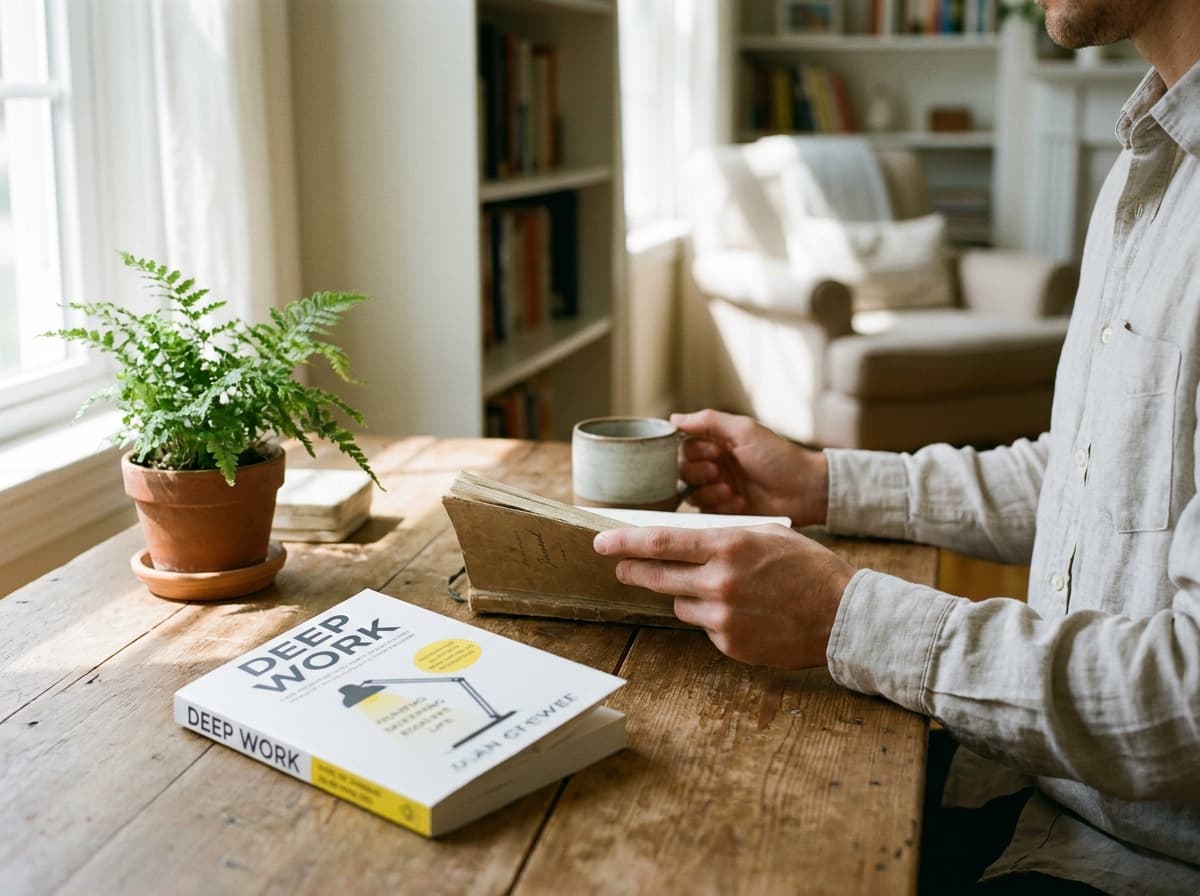
Why Your Brain Is Lazy (And How to Trick It Into Getting Stuff Done)
Ever feel like you’re fighting your own brain just to start a simple task? It’s not because you’re lazy, but because your mind is naturally wired to save energy. This...

ScoreRead Editorial Team
Editorial Team

Why Your Brain Is Lazy (And How to Trick It Into Getting Stuff Done)
Ever feel like you’re fighting your own brain just to start a simple task? It’s not because you’re lazy, but because your mind is naturally wired to save energy. This is where thinking fast and slow big ideas for better decision making come into play. Most of the time, we rely on quick mental shortcuts when we really need to engage our slower, logical side to get things moving.
We’ll look at a discipline vs motivation breakdown to see why waiting for a spark usually leads to a dead end. You’ll also find out how applying habit stacking to daily routines makes productivity feel automatic. If you’re stuck in a loop of worry, we’ll also cover overcoming the overthinking cycle with simple, self aware shifts that actually work.
By looking at the science of self discipline explained through proven research, you’ll get a clear roadmap to stop procrastinating. Let’s see how your brain works and how you can finally trick it into getting stuff done.
Ever feel like you’re the only one struggling to stay focused while your cat has the right idea just napping in a sunbeam? We see people crushing their goals and think they have some secret superpower. But here is the truth: that 'always-on' person is a myth. Everyone deals with a brain that would rather rest than tackle a big project. It is just how we are built.
Our brains are wired to take the path of least resistance. It is an old survival mechanism. Back in the day, saving energy meant staying alive, so your mind naturally avoids hard work. Understanding the science of self-discipline shows that it is less about willpower and more about managing your mental gears. Instead of fighting your nature, you can use habit stacking to make tasks feel as automatic as your morning coffee.
How do we move from overthinking to doing? Motivation is a fickle friend that disappears when you are tired. Real progress comes from systems that make the right choice the easy choice. By applying an idea breakdown of concepts like 'Thinking, Fast and Slow,' you can stop the procrastination cycle. Let's look at how to bridge the gap between knowing and doing.
Key insights:
- Productivity is a system you build, not a personality trait you are born with.
- Saving energy is a biological default, not a sign of laziness.
- Reliable systems and habit stacking beat temporary motivation every single time.
The Two Engines in Your Head: Thinking Fast vs. Slow
Imagine you are driving home on a route you have taken a thousand times. You pull into the driveway and suddenly realize you do not actually remember the last five miles. Your brain was essentially on cruise control while you focused on something else. This is what Daniel Kahneman calls System 1. It is fast, automatic, and incredibly efficient, but it is also where most of our mental shortcuts live. We like to think we are logical creatures making careful choices, but the reality is that our fast brain handles the bulk of our day to day life without us even noticing.
Then there is System 2. This is the slow, deliberate part of your mind that you use when you are trying to solve a complex math problem or learn a new language. It is the engine behind thinking fast and slow big ideas for better decision making, but it has one major flaw. It is lazy. Because thinking hard literally burns more energy, your brain would much rather rely on a gut feeling than do the heavy lifting of logical analysis. This is why we often choose the path of least resistance even when we know a better option exists. If a task feels too difficult, your brain tries to find a shortcut to get back to a state of ease.
You might wonder when it is actually safe to trust those instincts. The truth is that gut feelings are great for simple things like picking a movie or deciding what to eat for lunch. But when the stakes are high, like making a career move or a big investment, you need to wake up your slow brain. The danger comes from something called cognitive ease. When a situation feels familiar or easy, your brain assumes everything is fine and stays in low gear. This can lead to mistakes because you are not looking for potential risks. To get better results, you have to intentionally create friction to force your logical mind to take over.
Understanding these two engines is the first step toward better self awareness. Instead of waiting for a burst of motivation that might never come, you can design your environment to help your slow brain win. For example, think about the last time you tried to start a new habit. If it felt too hard, your fast brain probably talked you out of it. By making the right choices feel easier and the wrong ones feel harder, you are basically tricking your lazy brain into doing the work for you. This is how you bridge the gap between knowing what to do and actually getting it done.
Key insights:
- System 1 is your autopilot that relies on shortcuts to save energy and make quick calls.
- System 2 is your logical mind but it requires conscious effort and energy to activate.
- Cognitive ease can trick you into making quick decisions when you should be slowing down.
- Better decision making happens when you recognize which system is currently in charge.
When to Trust Your Instincts (and When to Run)
Ever had a gut feeling that something was just off, like a cat sensing a hidden cucumber? We usually hear that we should trust our instincts. But here is the catch. Your brain loves the easy path. This is called cognitive ease. While it feels as cozy as a sunbeam, it is often a trap that leads to lazy choices. It is the reason we stick to comfortable habits instead of pushing for real change.
Think about high-stakes moments like choosing a career path or managing your money. These situations require you to slow down and stop purring for a second. If a choice feels too simple or obvious right away, that is a red flag. You are likely stuck in fast thinking mode. To get better results, you have to force your brain to do the heavy lifting even when it wants to curl up for a long nap. It feels uncomfortable because it is supposed to.
How do you know when to run from your gut? Ask yourself if you are just choosing the path of least resistance. Real discipline comes from recognizing when your brain is trying to save energy at the expense of your long-term goals. Sometimes the best move is to stop and question that first thought. This is how you use self awareness to beat the overthinking cycle and finally get stuff done.
Key insights:
- Cognitive ease feels like confidence but is often just your brain being lazy.
- High-stakes decisions require slow thinking to avoid common mental traps.
- Self awareness helps you spot when your gut is just looking for an easy way out.
Motivation vs. Discipline: Why One Is a Total Lie
Waiting for motivation is like waiting for your cat to come when called. It might happen if the stars align and you have the right treats, but you'll spend a lot of time just standing there disappointed. The 'Motivation Trap' is the sneaky belief that we need to feel like doing something before we actually start. In reality, motivation is a fickle friend that usually only shows up after you've already started the work. If you wait for a feeling that never comes, you're letting your lazy brain win the argument before it even begins.
This happens because our brains are wired to save energy. In the world of thinking fast and slow, your brain prefers the easy, automatic path. Self-discipline is essentially the manual override for that system. It's not a magical personality trait that some people are born with while others aren't. Think of it as a muscle instead. If you only use it when you're feeling inspired, it stays weak. You build that muscle by doing the small, annoying tasks when you really don't want to, like cleaning the litter box right when you get home instead of waiting until tomorrow.
Doing the work when you aren't 'in the mood' is the real-life application of discipline. It’s about making a choice once and then following through without a daily debate. When you stop asking yourself 'Do I feel like doing this?' and start asking 'Is this what I planned to do?' you break the cycle of overthinking. It’s much easier to just move your feet than it is to convince your brain to be excited about a difficult task. Action creates the mood, and movement eventually triggers the motivation you were looking for in the first place.
The secret to building your boring superpower is choosing systems over goals. A goal is just a destination on a map, but a system is the actual car that gets you there. If you want a clean house, the goal is 'clean house,' but the system is 'ten minutes of tidying after dinner.' Systems beat goals every single time because they don't require you to be a hero. They just require you to follow a script. This is how you use habit stacking to daily routines for productivity. You simply anchor a new, disciplined behavior to something you already do, like checking your calendar while the coffee is brewing.
Your environment also plays a massive role in whether your discipline holds up or snaps. If you want to eat better but your counter is covered in cookies, you're forcing your brain to work too hard. Make the right choice the easy choice. Lay out your gym clothes the night before or put your phone in a drawer when you need to focus. By tweaking the world around you, you stop relying on willpower alone. It’s about being smart enough to know that your brain is lazy and setting up the room so that even a lazy brain can get stuff done.
Key insights:
- Motivation is a byproduct of action, not a prerequisite for it.
- Discipline is a practiced skill, not an inherent gift.
- Systems reduce the number of decisions you have to make, which saves mental energy.
- Environment design is more effective than relying on pure willpower.
Building Your 'Boring' Superpower
Ever wonder why big goals usually fizzle out by Tuesday? It is because goals are just a destination, while systems are the car that gets you there. In the discipline vs motivation breakdown for real life application, systems win every time. Think of it this way: a goal is wanting a tidy home, but a system is the habit of putting one thing away every time you leave a room. When you focus on the boring process, you stop relying on flaky motivation.
Real discipline is actually much lazier than you think. It is about tweaking your environment so you do not have to work hard to make a good choice. Think of it like a cat: if the treat jar is left open, they are going for it. Your brain works the same way. By applying habit stacking to daily routines for productivity, you use existing triggers to spark new actions. This is how you start overcoming the overthinking cycle with self awareness. You are not fighting your brain; you are just outsmarting it by making the good habit the path of least resistance.
The science of self discipline explained through top books shows that when we reduce friction, we win. By using an idea breakdown: thinking fast and slow big ideas for better decision making, you realize that your surroundings often dictate your choices. It is about being smarter than your biology, not just trying harder. When you design your space to support your habits, the boring stuff becomes your greatest superpower.
Key insights:
- Systems provide a reliable bridge where motivation usually fails.
- Environment design acts like a 'cheat code' for your willpower.
- Habit stacking uses your current routine to anchor new, productive behaviors.
The Magic of Habit Stacking: Building a Routine That Sticks
Ever feel like your brain is actively fighting you when you try to start a new habit? You are not alone. Most of us rely on motivation to get things done, but motivation is a fair-weather friend. It disappears the moment you are tired or stressed. This is where applying habit stacking to daily routines for productivity makes a massive difference. Instead of trying to build a new behavior out of thin air, you anchor it to something you already do without thinking. When we look at an idea breakdown of how successful people actually function, it rarely comes down to sheer willpower. They just have better systems.
The formula is incredibly easy to remember. You just say: After current habit, I will do new habit. Think about your morning. You probably brush your teeth or make coffee every single day without failing. If you want to start a journaling habit, do not just try to find time. Instead, tell yourself that after you pour your first cup of coffee, you will write one sentence. By linking the new action to an established trigger, you bypass the overthinking cycle that usually stops us in our tracks. It works for the evening too. You could decide that after you plug your phone in for the night, you will do two minutes of stretching.
But why does this work so well? It comes down to the science of self discipline explained through top books like Thinking Fast and Slow. Our brains love efficiency and shortcuts. When you complete a tiny task, your brain releases a little hit of dopamine. This makes you feel good and encourages you to do it again. This is why small wins are actually huge. They build the momentum you need to keep going when things get tough. It is about training your brain to enjoy the process of showing up.
A big mistake people make is the all or nothing mentality. They think if they cannot go to the gym for an hour, the whole day is a waste. That is just your lazy brain talking. A real discipline vs motivation breakdown shows that showing up for two minutes is much better than not showing up at all. When you focus on these tiny stacks, you stop worrying about being perfect and start focusing on being consistent. Over time, these small actions compound into life changing results without the burnout.
Key insights:
- Habit stacking uses existing neural pathways to make new behaviors feel automatic.
- The dopamine hit from a small win is more effective for long-term change than a single burst of intense effort.
- Focusing on the immediate trigger helps you avoid the trap of overthinking your goals.
Why Small Wins Are Actually Huge
Think about the last time you actually finished a massive project. It felt great, right? But waiting for those big moments is a recipe for burnout. Your brain actually craves the small stuff. Every time you finish a minor task, you get a quick hit of dopamine. This isn't just a 'good job' from your nervous system because it is actually the chemical fuel that drives you toward the next step. If you wait for a huge burst of motivation, you might be waiting forever.
The real danger is the all-or-nothing trap. We often assume that if we can't do it perfectly, it isn't worth doing at all. But applying habit stacking to daily routines proves that small wins are the real heroes. By linking a tiny new habit to something you already do, you stop the overthinking cycle before it starts. This is a key part of the discipline vs motivation breakdown because habits keep you going when your initial excitement fades. When you focus on winning the next ten minutes, self discipline becomes a series of small, easy choices instead of a mountain you have to climb.
Key insights:
- Dopamine acts as the chemical fuel for your next action, not just a reward for finishing.
- Habit stacking allows you to bypass the brain's instinct to overthink new tasks.
- Small, consistent actions are more sustainable than occasional bursts of high-intensity effort.
Stop the Spiral: How to Quit Overthinking and Just Start
Ever sat at your desk for an hour just thinking about the work instead of actually doing it? Your brain loves to spin its wheels while you stare at a blank screen. It is a classic trap where your mind tries to protect you from mistakes by over-analyzing every tiny detail until you are paralyzed. This is where overcoming the overthinking cycle with self awareness becomes your best tool. You have to notice that your brain is stuck in a loop before you can actually break out of it. It is like realizing your cat is chasing its own tail. It is funny for a second, but eventually, you need to step in and redirect that energy toward something useful.
Think about it like a countdown. When you feel that hesitation creep in, use the 5-second rule. You count down: five, four, three, two, one, and then you move. It sounds almost too simple to work, but it forces your brain to shift from that slow, analytical mode into a bias for action. This bypasses the part of your brain that wants to talk you out of being productive. You are not waiting for a spark of inspiration or a perfect moment. You are just moving. It is about physical action over mental debate. Once you start, the fear usually disappears.
We often wait for motivation to strike like lightning, but that is usually a losing game. The real secret lies in the discipline vs motivation breakdown for real life application. Motivation is a feeling that comes and goes, while discipline is a system you build. This ties back to the idea of thinking fast and slow big ideas for better decision making. Your fast brain wants comfort and snacks, but your slow brain knows that starting now is the only way to finish. If you wait until you feel like doing it, you might be waiting forever. Systems beat feelings every single day.
What if I fail? What if this looks bad? These questions are productivity killers that keep you stuck in the mud. Try flipping the script. Instead of asking what if, ask yourself so what? So what if the first draft is messy? So what if you have to redo a small part later? This takes the power away from the fear. Once you realize the worst-case scenario is usually just a minor setback, the spiral loses its grip on you and you can actually get to work. It turns a mountain into a molehill.
You can also try applying habit stacking to daily routines for productivity. If you always struggle to start a specific task, pair it with something you already do. Maybe you open your project management tool right after you take your first sip of coffee. By making the start automatic, you do not give your brain enough time to start overthinking in the first place. It becomes a reflex rather than a choice. It is the easiest way to trick your lazy brain into being a high achiever without all the mental drama.
Key insights:
- Self awareness is the first step to stopping a mental spiral before it takes over.
- Action creates momentum more effectively than waiting for motivation to arrive.
- The 5-second rule stops your brain from talking you out of difficult tasks.
- Asking so what helps lower the stakes and reduces performance anxiety immediately.
- Habit stacking removes the need for willpower by making starts automatic.
What the Science Actually Says About Self-Control
Ever wonder why you can resist a donut at 10 AM but find yourself face-down in a bag of chips by 9 PM? It is not because you are weak or lazy. Science shows our self-control works a lot like a muscle. If you use it all day making hard decisions at work, it gets tired and needs a break. This is why the science of self discipline explained through top books often focuses on systems rather than just trying harder. You only have so much go power before your brain wants to take the path of least resistance, much like a cat choosing the sunniest spot on the rug instead of chasing a toy.
In the book Thinking, Fast and Slow, Daniel Kahneman talks about how two systems in your head are constantly at odds. System 1 is fast, intuitive, and loves habits. System 2 is the logical part that handles self-control and complex choices. The problem is that System 2 is a total energy hog. When you are tired or stressed, System 1 takes over. This is where the discipline vs motivation breakdown for real life application becomes clear. Motivation is a feeling that comes and goes, but discipline is about setting up your life so System 1 does the right thing automatically.
One of the best ways to handle this is by applying habit stacking to daily routines for productivity. Instead of fighting your brain, you piggyback a new habit onto an old one. If you already feed your cat every morning, you can tell yourself that after you scoop the kibble, you will write down one goal for the day. It takes the heavy lifting off your willpower. You stop overthinking because the decision is already made. Overcoming the overthinking cycle with self awareness starts by realizing your brain is just trying to save energy and protect you from stress.
Here is the weird part: being nice to yourself actually helps you get more done. Most of us think that if we mess up, we need to be tough to get back on track. But research shows that self-compassion is a secret weapon for getting things finished. When you beat yourself up for procrastinating, you feel stressed and guilty. That stress makes your brain want to escape, usually by scrolling on your phone or eating junk food. If you just say, Okay, I missed an hour, let us start now, you lower that stress and make it easier for your brain to focus again.
Key insights:
- Willpower is a limited resource that drains as the day goes on.
- The idea breakdown for thinking fast and slow shows that our logical brain is easily exhausted.
- Habit stacking reduces the need for willpower by making actions automatic.
- Self-compassion prevents the stress cycle that lead to more procrastination.
Your New Game Plan
You know that feeling when your brain wants to scroll through social media instead of starting that big project? That is your fast brain taking the easy route. To actually get things done, we have to bridge the gap between those quick impulses and the slower, more disciplined parts of our minds. It is not about having a massive burst of motivation every single day. Motivation is fickle. Real progress comes from setting up a system where you do not have to think so hard about being productive.
Here is the one thing you should do differently tomorrow morning: pick your hardest task and commit to just five minutes of work on it before you even check your email. This simple act of habit stacking - connecting a new discipline to your existing wake-up routine - stops the overthinking cycle before it even starts. By the time your brain realizes it is working, you have already broken the seal. It is a small trick, but it uses the science of self-discipline to bypass that initial lazy resistance we all feel.
The reality is that building these habits is a marathon, not a sprint. You might stumble or have a day where the lazy brain wins, and that is okay. The goal is not to be a perfect robot; it is to be slightly better than you were yesterday. Keep showing up, keep stacking those small wins, and eventually, discipline becomes your default setting rather than a constant struggle. What matters most is the direction you are moving, not how fast you get there.
Key insights:
- Discipline beats motivation because it does not rely on how you feel in the moment.
- Starting with five minutes of a hard task bypasses the overthinking cycle.
- Consistency over time creates a default state of productivity.
Frequently Asked Questions
Think of System 1 as your brain's autopilot and System 2 as the manual override. System 1 is fast, snappy, and works on instinct, like how you instantly know a cat is cute without having to think about it. It is great for quick reactions, but it can sometimes jump to the wrong conclusions because it relies on shortcuts.
System 2 is the slow, logical side of your brain that handles the heavy lifting, like figuring out a complex budget or learning a new skill. It takes a lot of energy to use, so your brain naturally tries to stay in System 1 as much as possible. The trick is knowing when to wake up System 2 so you do not make impulsive choices based on a whim.
You do not need a perfectly timed schedule to make this work. Here is the thing: everyone has at least a few anchor habits they do without thinking, like waking up, making coffee, or even just sitting down on the couch. You just need to find one of those tiny moments and piggyback a new habit onto it.
If your day feels like a mess, start with something you definitely do, like putting on your shoes. You could say, 'After I put on my shoes, I will drink a glass of water.' It is way easier to attach a new behavior to something that is already happening than to try and build a whole new routine from scratch. Keep it so simple it feels almost too easy.
It's because motivation is a bit of a fair-weather friend. It shows up when things are new and exciting, but it usually leaves as soon as the real work starts. You aren't doing anything wrong, you're just experiencing how the human brain works. We get a quick hit of dopamine from the idea of a goal, but that chemical spike doesn't last for more than a few days.
Here's the thing, you'll find that successful people don't actually have more motivation than you. They just use discipline to bridge the gap. By using habit stacking, you can attach your new goal to an old routine. This makes the action feel automatic so you don't even have to think about it when your energy is low.
Sometimes it really is a hidden strength. Overthinking is often just your brain trying to be extra careful because it wants to avoid a mistake. In big moments, like picking a new house or switching jobs, that deep dive can help you spot risks that other people might miss entirely. It's basically your slow thinking system doing its job to protect you.
But you have to be careful. If you're just replaying the same worries without finding new answers, you're stuck in a loop. A good trick is to give yourself a worry window of ten minutes. Once that time is up, you have to trust your gut and take the next step. It's all about using that brain power for actual planning instead of just stressing out.
Conclusion
So, where does this leave your to-do list? It shows that your brain isn't actually lazy; it is just wired to save energy. When you look at a discipline vs motivation breakdown, it becomes clear that waiting for a feeling is a losing game. Real progress comes from understanding the science of self discipline explained through top books: it is about building systems that make the right choice the easy one.
By using thinking fast and slow big ideas for better decision making, you can catch yourself before you fall into a mental trap. Overcoming the overthinking cycle starts with that simple bit of self-awareness. Your best tool for this is applying habit stacking to daily routines, which turns big goals into tiny, automatic wins that your brain does not feel the need to fight.
You do not need to change everything at once. Just pick one small habit to stack onto your morning coffee tomorrow. Discipline is a muscle that grows every time you choose a system over a mood. Your brain might prefer the path of least resistance, but you are the one who gets to decide where that path leads.
Send it to someone who should read it next.
About the author

ScoreRead Editorial Team
Editorial Team
Every article on ScoreRead is researched, written, and edited by our editorial team before publishing, so the ideas we cover stay accurate, clear, and genuinely useful.
View all articles